In the leadership seat, you are constantly met with a familiar refrain from your department heads: “It’s more complicated than it looks.”
Whether it is a Marketing campaign’s attribution logic, a Legal compliance framework, or a complex software deployment, the “Complexity Card” is played every time a project stalls.
In the boardrooms I step into, this is the standard defense mechanism of the specialist. It is an attempt to drag the C-suite down into the weeds so that systemic inefficiency can hide behind “technical difficulty.”
Faced with this, the natural instinct—and I have felt this pull myself—is to roll up your sleeves and dive into the weeds. You want to validate why things are taking so long.
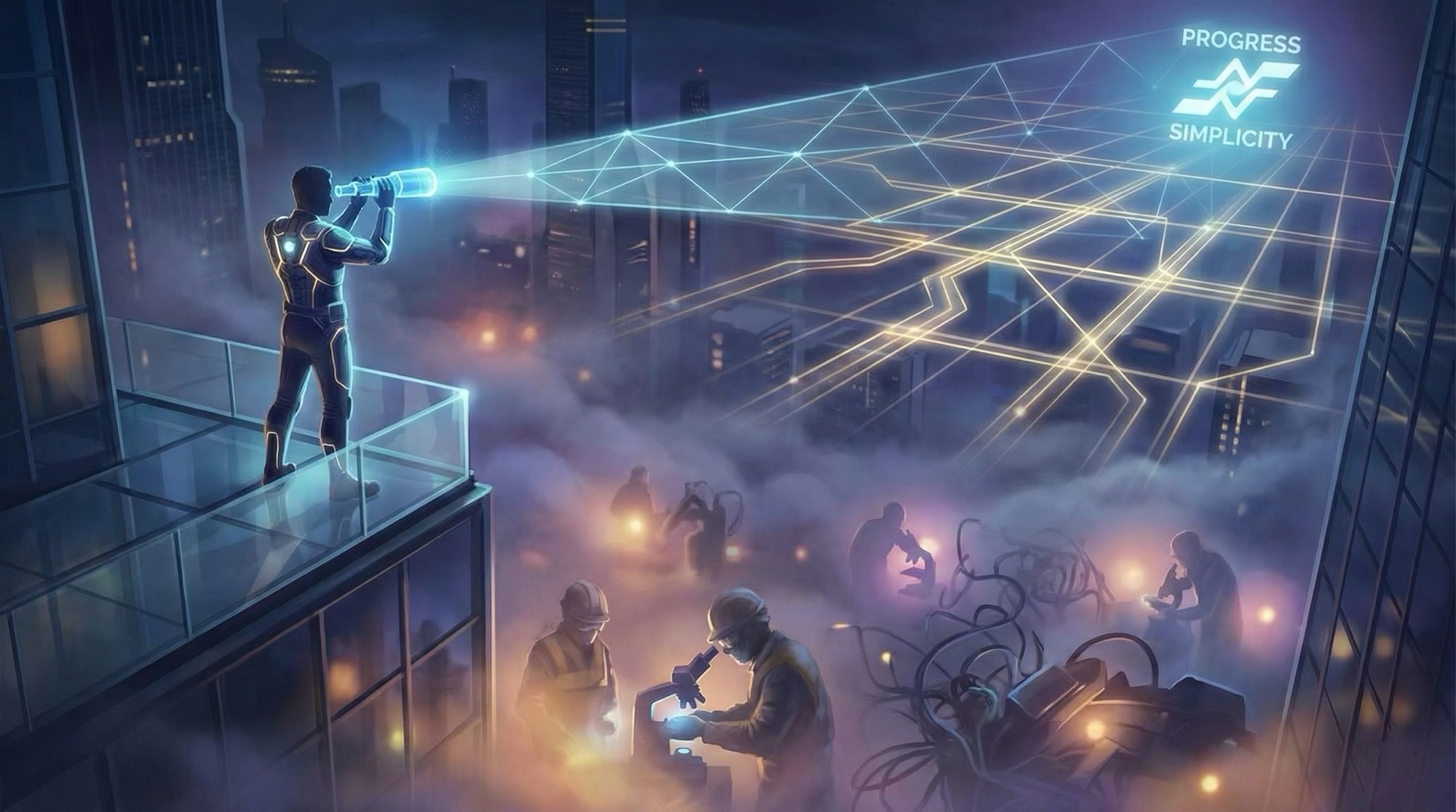
But this is where the perspective is lost. The moment we descend into granular details to verify those claims, we surrender our most valuable asset. We trade the telescope for a microscope.
While we are busy understanding the mechanics of a single departmental cog, the entire organization drifts off course. This is the Specialist’s Fog—a state where functional complexity obscures systemic flow, and “busy-ness” is mistaken for progress.
To act as a true Value Stream Architect, we must master the art of being “dangerously informed” without being “tactically ensnared.” This is about maintaining the Clarity Buffer required to see the geometry of value that no one else in the room can see.
The High Price of Local Optimization
The urge to dive deep is a symptom of a systemic trust failure, but the cost is Local Optimization. Spending three days understanding the nuances of a new CRM implementation or a specific tax structure is an act of senior management, not architectural leadership.
Even a “fix” at that level is often an illusion. As Eliyahu M. Goldratt demonstrated in the Theory of Constraints, any improvement made anywhere other than the primary bottleneck is a waste of capital.
If the Value Highway is blocked by a slow legal approval chain or a fragmented sales-to-onboarding hand-off, having the most efficient Marketing engine in the world adds zero dollars to the bottom line.
Our role is to identify the warehouse bottleneck, not to help the factory workers speed up the machines.
Governing the Black Box
Architectural leadership requires treating functional execution as a “Black Box.” We don’t manage the tasks; we manage the conduits.
This means ruthlessly prioritizing the Value Delta—the transformation gap between what is and what could be—rather than getting lost in the “how.” If the complexity described doesn’t result in a significant leap in potential, it is simply waste.
The goal is to pave the conduits between silos, ensuring that an idea travels from inception to market without being diluted by departmental friction.
This is about protecting Cognition; a leader who micromanages tactical weeds bankrupts the clarity required for high-level problem-solving.
We demand simplicity not for its own sake, but because simplicity is the only thing that allows for exponential leverage through automation and AI.
Piercing the Fog through Triangulation
A high-level position naturally creates The Illusion of Simplicity. This is the breeding ground for the “Watermelon Effect”—projects that appear Green on the outside but are Red internally.
To avoid being misled, we don’t need more departmental detail; we need Feedback Loops that verify the “physicality” of the flow.
Drawing from John Boyd’s OODA Loop, the “Observe” phase must be unfiltered. Ignore departmental status reports and focus on the pulse of the system through Flow Metrics:
- Flow Efficiency. The ratio of time work is moving versus sitting in an inbox.
- WIP (Work in Progress). The volume of unfinished projects clogging the system.
- Throughput. Finalized value units actually reaching the market.
To ensure these metrics aren’t being “gamed,” I use a Triangulation Grid. Verify reality through three points: boardroom narratives, hard systemic data, and the Gemba—the ground truth from the frontline.
If these three points do not align, we have an architectural compromise that will eventually become a financial disaster.
The Erosion of Leverage
The greatest cost of the “Deep Dive” is the erosion of leverage. When we spend cognitive capital understanding the “how” of a broken manual process, we are implicitly validating its existence.
We become experts in a system that should not exist. When met with complexity, the question isn’t “how does it work?” but “how can this be simplified enough for an AI agent to execute?”
Evolution requires exponential leverage. If a process requires C-level attention just to keep it running, that process is a liability. It is a parasite on the organization’s cognitive resources.
Complexity is a signal for automation, not an invitation for more management.
The Brutal Truth
Specialists build the walls; the Architect ensures the building stands. If we try to carry the bricks, we drop the blueprint.
The urge to “dive deep” is often an ego-driven desire to prove we are still “in touch.” It is a comfort zone where we can solve tangible problems instead of facing the messy, intangible problems of organizational architecture.
Our value is not in understanding the complexity, but in the courage to demand that the complexity be distilled into Value.
Discover more from HOGOFLOW
Subscribe to get the latest posts sent to your email.