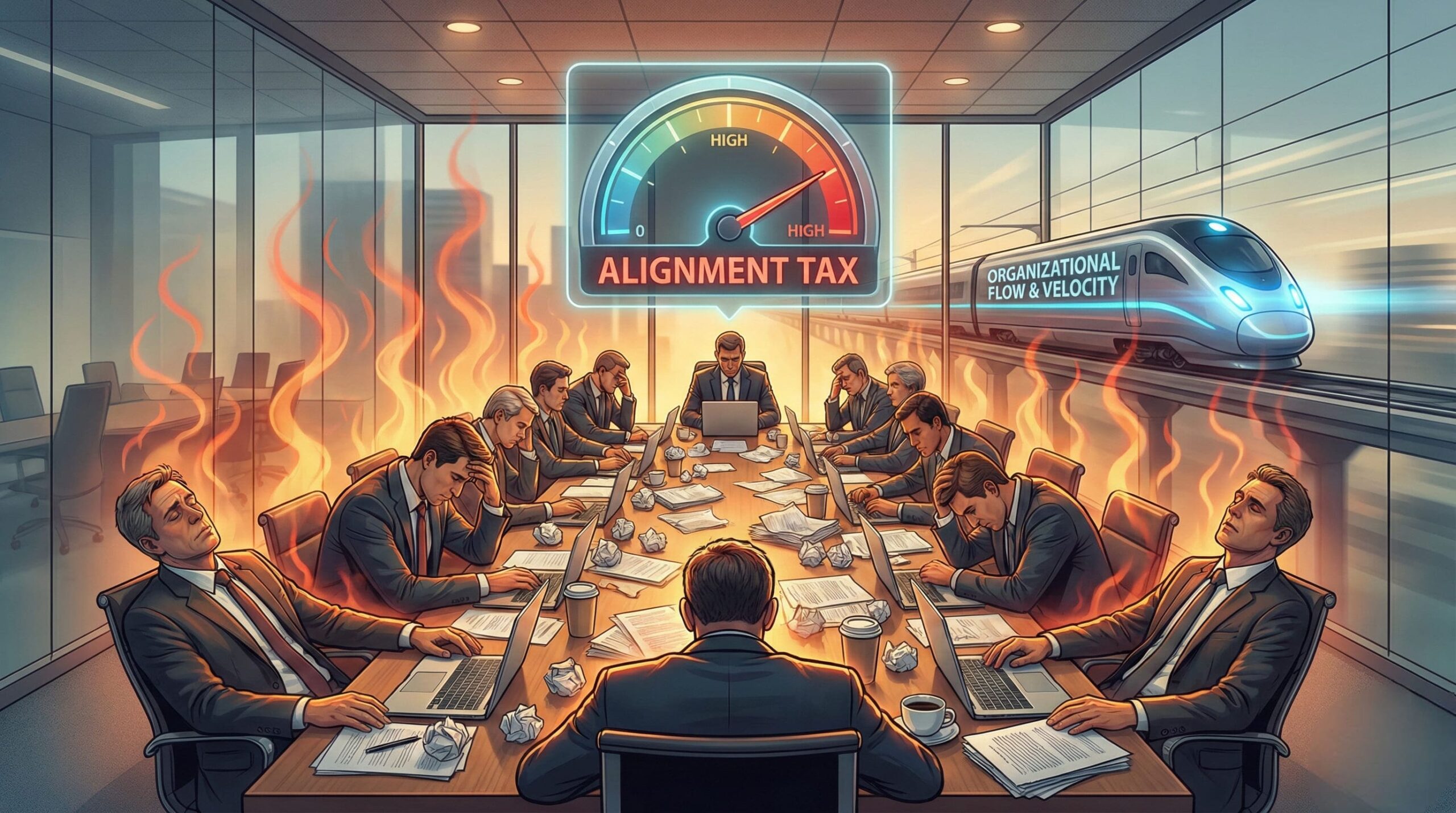
Cash flow is a lagging indicator of architectural health. Most leaders squint at the balance sheet to see if they are winning, but the real story is written in the calendar.
If your organization spends sixty percent of its week “aligning,” you aren’t running a high-performance engine. You are operating a radiator that converts capital into heat.
I call it the Alignment Tax.
This tax is the silent killer of market velocity. It is the invisible friction that exists between a brilliant idea and a deployed solution.
In the C-suite, we often treat “alignment” as a cultural virtue—a sign of a healthy, collaborative environment. That is a dangerous delusion.
Alignment, when mismanaged, is high-interest debt that compounds every time a decision is deferred.
The Capital Freeze
Your Board cares about ROI. They care about how quickly one dollar of investment turns into five dollars of revenue.
But look at your current value stream. We are watching projects bleed capital because the cost of coordinating has surpassed the cost of producing.
This isn’t a talent problem. Your people are brilliant. It is a liquidity problem.
Every time a meeting ends with the phrase “let’s circle back after checking with the Regional Officer (RO),” you have frozen a block of intellectual capital. That capital is now sitting in a queue. It earns zero interest. It creates zero value.
In fact, it depreciates as the market shifts. We are paying expert wages for people to sit in rooms and wait for permission.
This is systemic waste. If we treated physical inventory with the same negligence we treat “decision inventory,” the CFO would be calling for heads.
Why does this happen? Systems thinking teaches us to look for the feedback loops.
In most corporate architectures, the feedback loop for risk is hyper-sensitive, while the feedback loop for delay is non-existent.
In The Principles of Product Development Flow, Donald Reinertsen identifies these queues as the root of all waste. Traditional management focuses on “Resource Utilization”—keeping everyone busy. But high utilization leads to exponential increases in queue length.
When your key decision-makers are fully booked in “alignment meetings,” the queue of pending decisions grows until the system reaches a standstill.
The root cause is a lack of distributed decision-rights. We have built systems where the authority to say “No” is distributed everywhere, but the authority to say “Yes” is concentrated in a few bottlenecked nodes.
The Entropy of Coordination
To understand why “more alignment” leads to “less progress,” look at the Second Law of Thermodynamics: Entropy.
In any closed system, energy tends to dissipate into a less useful state. In physics, this is heat. In an organization, this is coordination overhead.
As you add more moving parts—departments, stakeholders, layers of management—the energy required just to keep the parts from crashing into each other increases.
Eventually, you reach a point where the system’s energy is spent entirely on internal maintenance. Zero energy is left for production.
We are fighting the law of entropy with more meetings. It’s like trying to cool a room by leaving the refrigerator door open. The motor works harder, creates more heat, and the net temperature of the house actually rises.
We don’t need more “cooling” (coordination); we need a more efficient “engine” (architecture).
The Insurance Quagmire
I see this most clearly in the insurance sector—an industry that has perfected the art of “Alignment” to the point of systemic paralysis.
Imagine we are launching a new Digital Sales feature, a simple “Quick-Quote” tool designed to slash the sales cycle from days to minutes.
To get this live, you need the blessing of the High Council: Legal, Compliance, Security, and Core Systems. You gather these stakeholders. You spend four thousand dollars an hour in cumulative salary.
But here is the fatal flaw: Nobody in the room has the mandate to say “Go.”
Every representative at the table is a “Proxy.” When a critical decision arises—say, how to handle data privacy consent without killing the user experience—the room goes silent.
Then comes the phrase that kills momentum: “I need to run this by my RO (Regional Officer) first.”
In economics, this is the Principal-Agent Problem, formalized by Michael Jensen and William Meckling. The “Principal” (The Board) wants value. The “Agent” (The Department Rep) wants to minimize personal risk.
The “RO Syndrome” is a rational response to a system that penalizes initiative and rewards “The Trail of Paperwork.”
It is a Byzantine Bureaucracy where the goal is no longer to win the market, but to ensure that if the ship sinks, no one can point at your specific department as the cause.
The Messenger Trap
We are paying expert wages for signal processing. When a Senior Architect or a Director sits at a table but lacks the mandate to commit, they aren’t an expert. They are a Human Router.
They take information from point A and pass it to point B. This is a catastrophic waste of human potential.
We hire these people for their judgment, then strip them of their agency. This is a system design flaw, not a personality trait.
If your leaders need to ask for permission to execute the strategy they were hired to lead, you have a trust deficit masquerading as a process.
Your best people will leave. High-agency individuals cannot stand the smell of stagnant queues. They want to build, not route packets.
Designing for Flow
To fix the architecture, we must stop managing people and start managing the flow of decisions.
Decision-Rights Architecture: We must redefine what it means to be “in a meeting.” If you are in the room, you must have the authority to commit. No proxies.
We must push authority to where the information is, not move information to where the authority is, as David Marquet suggests in Turn the Ship Around!.
The Table Mandate: Presence requires the autonomy to commit resources in real-time. If a department cannot send someone with the power to decide, that department loses its seat at the table.
This eliminates the “departmental observer”—the person who is there just to protect their boss’s territory.
Fast-Lane Guardrails: Build pre-approved boundaries where teams execute without a permission slip. In organizational design, we need Policy-Based Governance.
If the cost is under a certain threshold and the risk profile is standard, the team has a permanent “Yes.”
Quantifying the Ghost: We cannot manage what we do not measure. Use the Cost of Delay calculator to force decisions.
When you tell a stakeholder that “checking back with the RO” will take three days, and those three days represent fifty thousand dollars in lost market opportunity, the “need to align” suddenly feels a lot less urgent.
You turn an abstract process problem into a concrete financial loss.
The goal isn’t to have everyone agree. The goal is to have everyone commit.
In the old world, we sought 100% consensus to minimize the “blame footprint.” In the new world, we seek “informed dissent” followed by rapid execution.
We must stop managing compliance—the act of making sure everyone followed the “alignment process”—and start managing the performance of the value stream.
The Alignment Tax is a choice. You can continue to pay it, watching your margins evaporate in the heat of endless meetings, or you can re-architect for flow.
It requires courage to give up the “illusion of control” that centralized decision-making provides, but the reward is a system that actually moves.
Your people aren’t waiting for instructions; they are waiting for permission. If you want to double your organizational throughput without hiring a single new person, simply give them the mandate to say “Yes” at the table.
Discover more from HOGOFLOW
Subscribe to get the latest posts sent to your email.