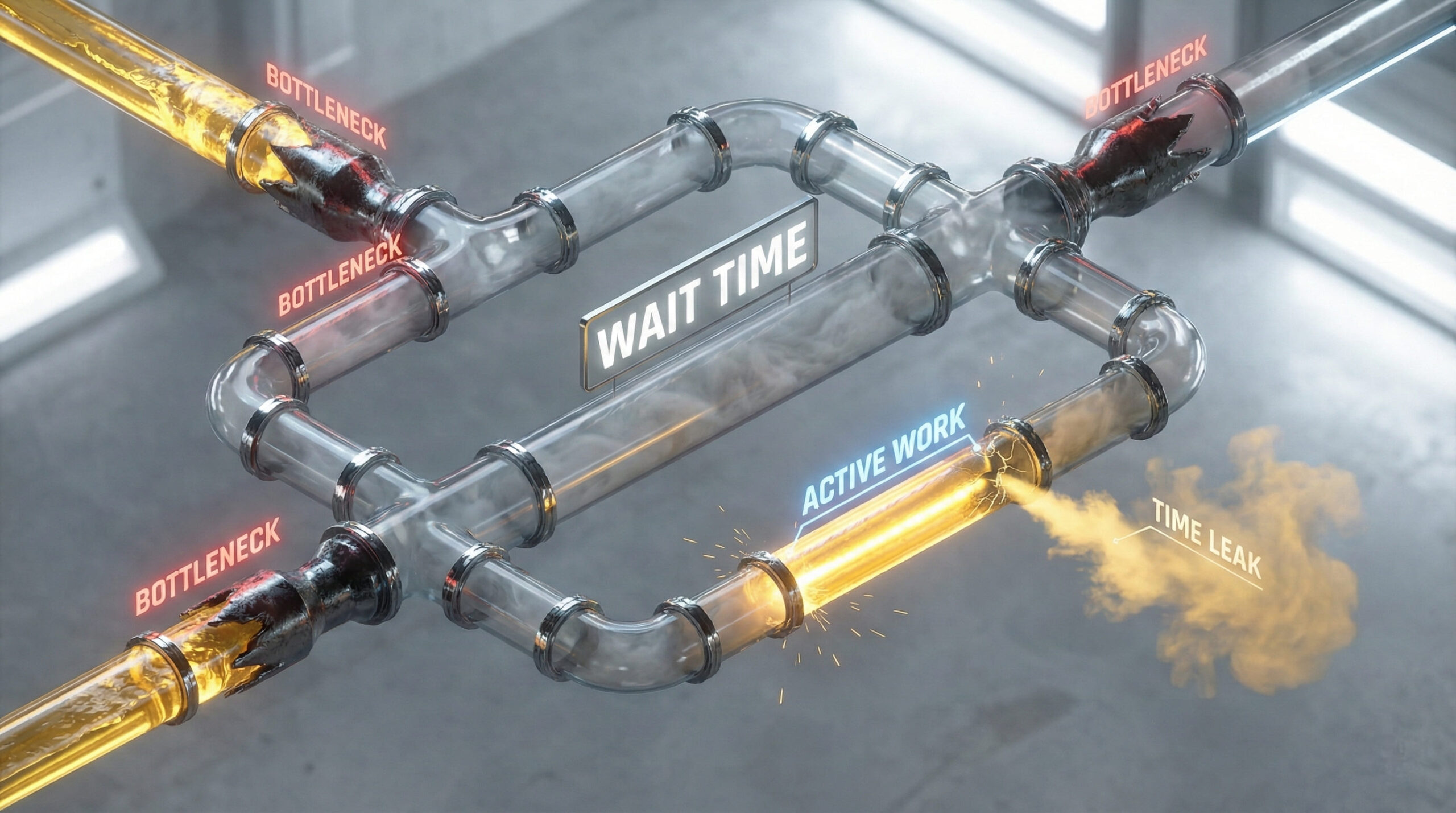
I have sat in boardrooms where “utilization” was 100% and value was 0%. Most executives are flying blind, mesmerized by dashboards that track how busy their people are while the actual work—the capital—sits decaying in a queue. It is a systemic delusion. We obsess over headcount while ignoring the fact that our value streams are clogged with digital dust. If you want the truth about your organization’s health, look at Flow Efficiency. It is the only mirror that does not lie.
The Paradox of the 100% Busy System
Maximum utilization is the fastest way to trigger a total system collapse. We’ve been trained to believe that idle hands are wasted money. Wrong. In any complex workflow, when you pack calendars to the breaking point, you aren’t optimizing talent; you’re building an expensive parking lot.
Think of a highway. If the road is 100% full, speed drops to zero. This isn’t a guess; it is Kingman’s Formula (developed by Sir John Kingman in 1961), which proves that as you approach 100% capacity, wait times don’t just grow—they explode. You aren’t maximizing your talent. You are ensuring that nobody has the breathing room to actually move the work toward the finish line.
Dominica DeGrandis, in her book Making Work Visible, identifies “Wait Time” as the silent killer of productivity. When work stops, it loses context. It becomes obsolete. It requires “re-learning.” We don’t have a talent problem. We have a “work-sitting-still” problem.
The Architecture of Decay
To fix the system, you must first measure the rot. Flow Efficiency is the diagnostic tool for the Value Stream Architect. It strips away the ego of “being busy” and exposes the friction in your governance.
- Active Work Time: The actual minutes a human is adding value.
- Total Elapsed Time (Lead Time): The clock time from “Ready” to “Done.”
The 19% Reality: A Case Study in Systemic Failure
A 19% Flow Efficiency is a flashing red light. It tells me that for every 100 hours a project spends in your “system,” only 19 hours involve someone actually working. The remaining 81 hours? Pure waste. Dead air. Your capital is suffocating in a queue.
I have seen this pattern in dozens of Tier-1 IT organizations. Leaders focus on keeping everyone busy—the “Five Thieves of Time” as DeGrandis calls them: too much Work in Progress (WIP), unknown dependencies, unplanned work, conflicting priorities, and neglected work.
- The Wait State Trap: 81% of your Lead Time is “Wait Time.” Work is sitting in “Pending Approval” or “Awaiting Deployment.” Your organization is a collection of silos connected by slow-moving conveyor belts.
- The High Cost of Delay: In The Principles of Product Development Flow, Donald Reinertsen argues that the cost of delay is often ignored because it’s invisible. At 19%, your time-to-market is five times longer than it needs to be. You aren’t just slow. You are expensive.
- Context Switching Pathology: When work stops, people start something else. This creates a feedback loop of high WIP. A death spiral of busy-ness without progress.
The Invisible Graveyard of Market Share
The 81% waste isn’t just a payroll leak; it’s a strategic hemorrhage. While your work-in-progress (WIP) sits decaying in a queue, the market isn’t hitting “pause.” Every hour of “Wait Time” is a gift to your faster competitors. In the age of digital Darwinism, speed is the only sustainable moat. If your time-to-market is five times longer than it should be, you aren’t just paying for idle hands—you are paying for the privilege of becoming obsolete. You are funding your own replacement by giving rivals a multi-month head start to capture the customer feedback loops that should have been yours.
The Brutal Truth: Your “Cost of Delay” is often higher than your entire R&D budget. You’re not losing pennies; you’re losing the future.
Source: Donald Reinertsen, The Principles of Product Development Flow.
Why Your Fixes Aren’t Working
Most VPs react to these numbers by hiring more engineers. This is a fundamental systems-thinking error. If your pipes are clogged, increasing the water pressure (adding people) just causes the pipes to burst.
Traditional management treats work like a relay race where we focus on the runners. In reality, value delivery is about the baton. A 19% efficiency means the baton is lying on the grass 81% of the time while the runners are doing jumping jacks to look busy.
The Architectural Solution: Designing for Flow
Whether targeting 40% flow efficiency in complex IT—a level considered world-class by Dominica DeGrandis—or the 90% benchmark typical of high-performance Lean manufacturing, the mandate is identical: stop managing people and start architecting the Value Stream.
- Visualize the Wait States: Most Jira boards show what people are doing. I want to see where work is stuck. If your board doesn’t have “Wait” columns between every “Active” column, you are flying blind.
- Kill the Handoffs: Handoffs are the primary source of decay. As Mik Kersten highlights in Project to Product, functional silos (Dev, QA, Ops) are flow killers. Move toward cross-functional “Product Value Streams.”
- Aggressive WIP Limits: Stop starting. Start finishing. Reducing active items reduces wait times. It is counter-intuitive to the C-Suite, but doing less at once delivers more over time.
Stop asking if everyone is busy. That question is exactly what got you to 19%. You cannot optimize individuals into a high-flow system. You have to design the system so that the path of least resistance is the path of flow. Your job is not to whip the runners. It is to clear the track. The system’s design dictates the waste, not the people within it. Change the architecture, or accept the decay.
Discover more from HOGOFLOW
Subscribe to get the latest posts sent to your email.