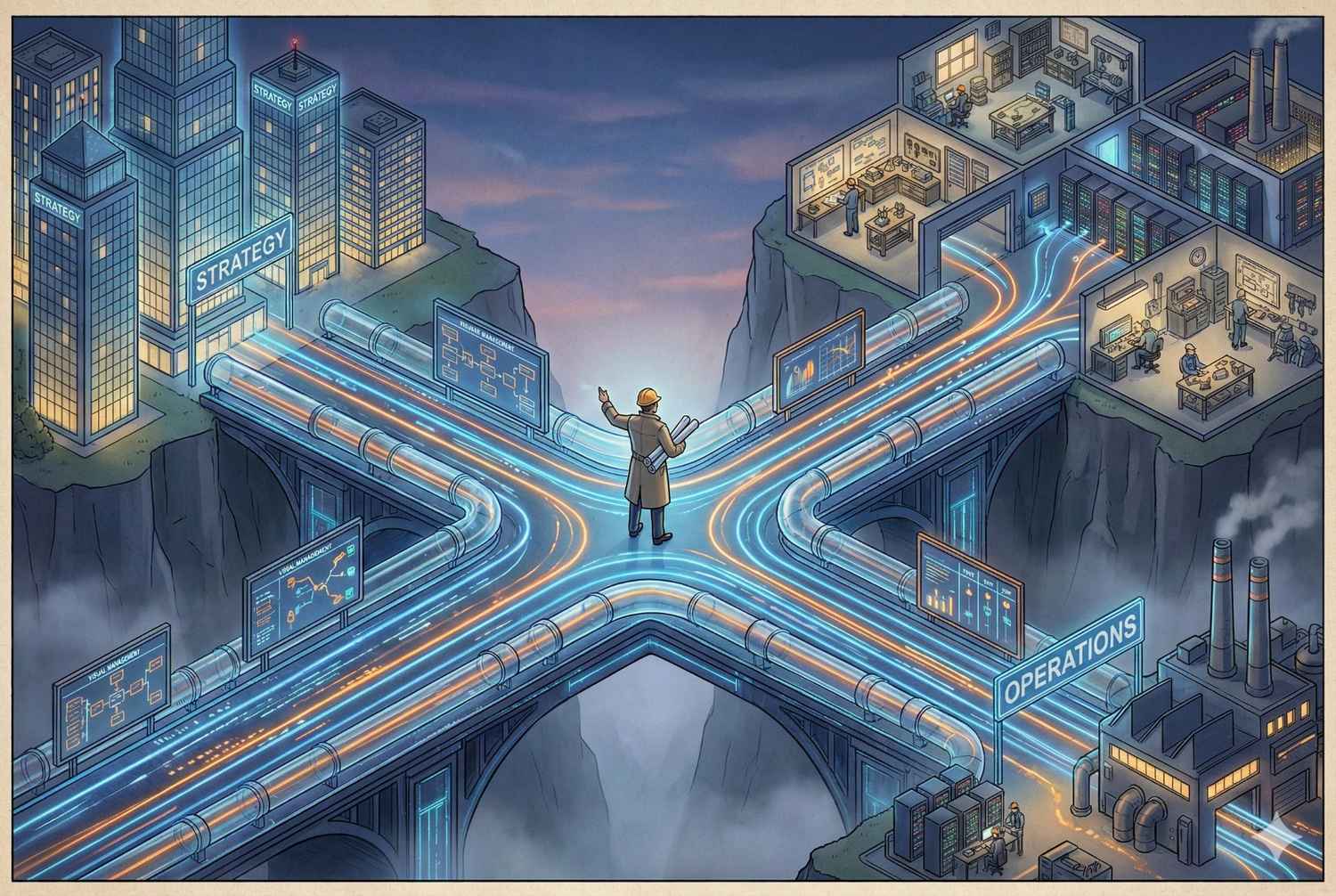
If you have ever stood in the shoes of a Release Train Engineer (RTE) or a Project Director at scale, you know the specific flavor of anxiety I’m talking about: the feeling of standing directly in the crossfire.
On one side, you face the “Strategic Commitment”—the CEO and the Board breathing down your neck with non-negotiable deadlines. On the other side, you face the “Operational Reality”—tech leads warning that the platform is red-lining and drowning in technical debt. The brutal truth? Both sides are absolutely right. And that is exactly why this conflict destroys so many managers.
Early in my management career, I wasted three years trying to play referee. I remember sitting in a budget meeting, sweating through my shirt, trying to explain the concept of “Code Refactoring” to a CFO who only cared about feature release dates. I lost that argument every single time. I tried to explain burnout to the Business, and I tried to explain P&L pressure to the developers. The result? I got exhausted, and the two sides still hated each other.
Looking at this through the lens of a Workflow Architect, I realized the truth. The problem wasn’t that people were difficult or lazy. The problem was a system design flaw. These two forces—Strategic Push and Operational Pull—are not enemies. They are parallel realities. The job of a leader isn’t to pick a side. It is to architect an “Interface” that allows these two worlds to connect without destroying each other.
The Flaw in the Wallet (Fixing the Strategy)
Let’s look at the root cause first. Why is the pressure from Business often so chaotic? Usually, it comes down to “Project-Based Funding”—a legacy mindset that I have zero tolerance for. The model operates on a cycle of destruction: Approve a budget for Project X, scramble to hire or steal people to form a team, work frantically, and then disband them. This is literally designing chaos into your system on purpose. You cannot measure the throughput of a factory if you tear down the assembly line every six months.
The architectural solution is to move to Stable Value Stream Funding. Stop funding temporary projects. Fund a “Train”—a stable team of teams with a fixed annual budget. When you do this, the conversation changes. It stops being “How much will this cost and when will it be done?” and starts being “We have a fixed capacity of 100 people; what is the most valuable work we can feed them this quarter?” You turn chaotic “Push” into rational investment logic.
The Reality Check (Fixing the Execution)
Now, look at the execution layer. The friction point is usually PI Planning (or Big Room Planning). In dysfunctional organizations, PI Planning is just a “Briefing Session” where leadership stands on stage reading a wish list, and teams nod in terror while secretly updating their resumes. That is not planning; that is theater.
For me, planning must be a Negotiation. And the only currency accepted in this market is Capacity. I tell my teams: Drop the feelings. Don’t tell me “We are busy.” Show me the math. “Based on the last 3 quarters, we have a velocity of 40 points. You asked for 60. Which 20 are we dropping?”
By using Capacity as a hard currency, we force the Business to make trade-offs before the work starts, rather than discovering the bottleneck three months later when we miss the date. If the bucket is full, it’s full. You can scream at the bucket, you can threaten it, but it won’t hold more water. The system has to respect physics.
The “Valve”: Portfolio Kanban
So, we have stable funding (Input) and data-driven capacity (Execution). How do we connect them? We need a valve. I use a strictly managed Portfolio Kanban.
Think of it as an airlock. On the left (the Funnel), leadership can dream up a thousand ideas. They can put whatever they want there. But—and this is the critical constraint—work cannot cross into “Implementation” until the Trains actually “Pull” it. My job as the Architect is to guard that gate and watch the WIP (Work In Process) limits.
When a stakeholder demands: “We need to start this AI initiative right now!”, I don’t argue emotionally. I point to the board: “Okay. The Trains are at 100% capacity. To pull the ‘AI’ card in, we have to move the ‘Mobile App’ card out. Are you willing to pause the Mobile App?” This transparency kills “Shadow Work”—the secret DMs and “quick favors” that destroy productivity. It forces everything through the interface. We stop asking “Why is the team so slow?” and start asking “Why are we jamming the funnel?”
The Shift
It is time to stop treating human error or missed deadlines as a moral failing. If a team forgets a task or burns out, it is rarely because they are bad employees. It is because the system was designed to allow over-commitment.
Shift your mindset. Stop trying to be the hero who absorbs the stress. Stop trying to be the “nice guy” to the team or the “yes man” to the CEO.
Be the Architect.
Your value is in building a system where funding is stable, planning is based on math, and a clear interface forces trade-offs upstream. When you do this, Strategy and Execution stop colliding and finally start feeding each other.
Discover more from HOGOFLOW
Subscribe to get the latest posts sent to your email.