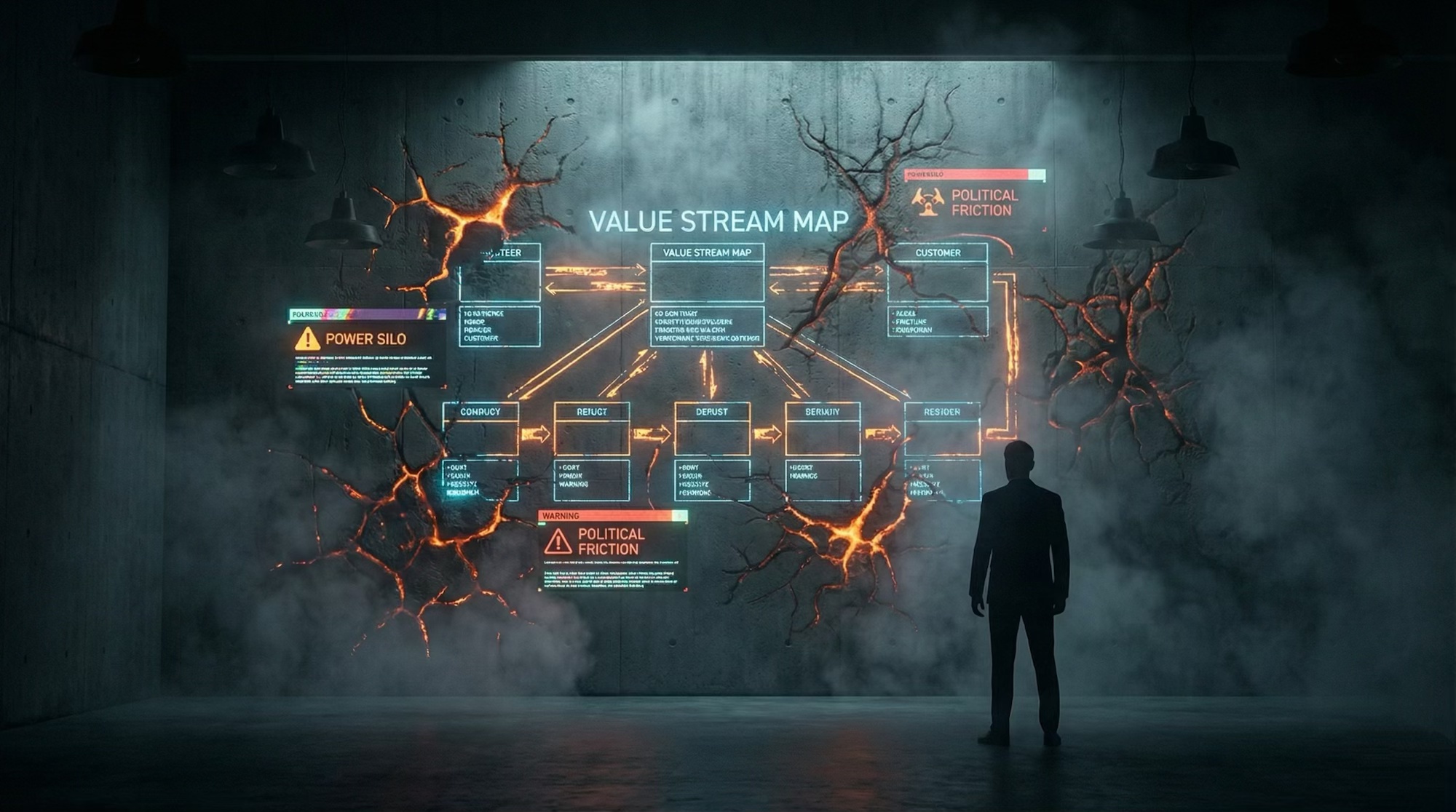
Digital transformation is a graveyard of good intentions and expensive licenses. We pour millions into “Agile” and “Cloud,” yet the needle barely moves.
Why? Because we treat the organization like a computer that needs a software update, when it’s actually a biological organism protecting its own dysfunction. Most leaders look at a Value Stream Map and see a path to efficiency. I look at it and see a battlefield of hidden agendas.
We’ve been taught that if we just map the flow, find the bottlenecks, and automate the manual steps, the system will heal. That is a lie.
The map is not the territory. The territory is a jagged landscape of ego, historical trauma, and survival instincts. Those “redundant” manual reports and “unnecessary” approval gates aren’t just waste. They are Political Scar Tissue.
In my years architecting value streams, I’ve learned that you can’t optimize a process until you’ve decrypted the incentives behind the friction.
If you try to remove a manual gate that gives a Director their sense of importance, the system will treat you like a virus. It will mobilize its white blood cells—bureaucracy, “risk compliance,” and endless steering committees—to eject you.
The Anatomy of Political Scar Tissue
Every time a project failed in the past, someone added a checkbox. Every time a budget was overspent, someone added an extra layer of approval.
Over a decade, these layers harden. They become the “standard operating procedure.”
To the untrained eye, it looks like inefficiency. To the architect, it’s a series of historical defenses.
In systems thinking, we talk about the difference between the Espoused Theory (what the company says it does) and the Theory-in-Use (what the company actually does) [Source: Organizational Learning, Chris Argyris and Donald Schön].
Most transformations fail because they try to optimize the Espoused Theory while the Theory-in-Use is actively working to sabotage it.
If a Senior VP’s bonus is tied to the size of their headcount, they have zero incentive to automate manual data entry.
Automation reduces headcount. Therefore, automation is a threat to their mortgage.
You can bring all the ROI spreadsheets you want; logic is a blunt instrument when used against someone’s survival instinct.
This is why “bringing data to the meeting is like bringing a spreadsheet to a gunfight.”
You aren’t arguing about flow; you are arguing about power.
The Toll Booth Economy
Think of every manual handover as a toll booth. In a high-trust organization, the toll is zero.
In a low-trust, politically charged environment, the toll is high. The “toll” is paid in time, ego-stroking, and political favors.
“Whenever there is a handover of work, there is a loss of information and an increase in noise.” [Source: The Goal, Eliyahu M. Goldratt].
But in the political layer, that “noise” is actually a signal of control. When a manager says, “I need to review this before it moves to the next stage,” they aren’t looking for quality.
They are marking their territory. They are ensuring that the value stream cannot function without their presence.
This is the ultimate defensive moat. Efficiency, in this context, isn’t a gift—it’s an existential threat to their relevance.
Interface Decoupling
If you cannot change the culture—and let’s be honest, as an architect, you rarely can change it overnight—you must re-design the interface.
In software, we use API gateways to decouple a modern microservice from a legacy monolith. We should apply the same thinking to organizational design.
I call this the Interface Decoupling Strategy.
Instead of trying to “fix” the bloated bureaucracy of the entire enterprise, you encapsulate your high-performance value stream. You create a “clean room” where your team operates with lean principles, high automation, and zero manual handovers.
However, at the boundary of your stream, you build an adapter. This adapter’s sole job is to translate your lean outputs into the “artifacts” the bureaucracy craves.
Does the PMO want a 50-page manual report? Don’t argue with them. Automate the generation of that report from your real-time data and send it to them.
Satisfy the “immune system” of the organization so it leaves your team alone. You aren’t lying to the system; you are “feeding the beast” to preserve the flow of the engine.
The Strangler Fig for Organizations
In software architecture, the Strangler Fig Pattern involves building a new system around the edges of an old one, letting it grow until the old system is eventually replaced [Source: Martin Fowler, 2004]. We must do the same with value streams.
- Identify a Greenfield Stream: Don’t try to fix the core legacy product first. Pick a new initiative where the “scar tissue” hasn’t fully hardened.
- Architect for Autonomy: Design the team, the tech stack, and the deployment pipeline to be entirely self-contained.
- Bridge the Gap: Use the Interface Decoupling Strategy to satisfy the external corporate requirements (Legal, Finance, Compliance) without letting those departments “touch” the internal flow.
- Starve the Old System: As the new stream proves its ROI and speed, begin migrating talent and resources out of the “swamp” and into the “new city.”
Respecting the Immune System
One of the hardest lessons I’ve learned is that being “right” is the fastest way to get fired.
If you walk into a C-suite meeting and point out that the current process is a monument to waste, you have just insulted everyone who built that process. You have triggered the organizational immune system.
Systems tend toward Homeostasis—the tendency to maintain a stable, constant internal environment [Source: Thinking in Systems by Donella Meadows].
When you introduce “radical efficiency,” the system views it as an instability.
To survive, you must frame your architectural changes as a way to strengthen the existing power structures, even if your ultimate goal is to bypass them.
For example, don’t talk about “removing approvals.” Talk about “elevating leadership to strategic oversight by automating tactical validations.”
You are saying the same thing, but one sounds like a promotion while the other sounds like an execution.
The Cost of Stale Information
We must develop a visceral intolerance for stale data. In a modern value stream, if information is more than a few minutes old, it is a liability.
Manual data entry is the primary cause of this rot. When a human has to type data from one system into another, they aren’t just wasting time; they are introducing a “half-life” to the truth.
By the time that manual report reaches a VP’s desk, it is a fossil. Decisions made on fossils are, by definition, reactionary.
A Value Stream Architect’s job is to ensure that the “sensor-to-shooter” loop—the time between seeing a market signal and deploying a response—is as close to zero as possible.
If the political structure requires a 2-week lead time for a decision, no amount of Jenkins pipelines or Jira boards will save you.
Know When to Quit
There is a point where the organizational OS is so corrupted, so laden with Political Scar Tissue, that “transformation” is a waste of capital.
Great architects don’t build skyscrapers on shifting sand. If the leadership uses complexity as a defensive moat and refuses to address the underlying incentives, the project is dead on arrival.
Talent is the most expensive and volatile asset in your architecture.
If you force high-performing engineers and product thinkers to work inside a system designed for stagnation, they will leave.
You will be left with the “C-players”—the people who have learned to navigate the bureaucracy because they can’t navigate the code.
At this point, you have two choices:
- Re-architect the Environment: This requires a mandate from the very top (CEO level) to burn the old incentive structures down.
- Build a New Machine: Start a separate entity, a “Skunkworks,” or a subsidiary that operates on a completely different OS.
We need to stop being “process doctors” trying to heal a body that wants to stay sick.
If the head—the leadership—derives power from the sickness (complexity and lack of transparency), no amount of Agile coaching will help.
The shift in mindset is this: Stop looking at the flowchart. Start looking at the people.
- Map the incentives.
- Identify the toll booths.
- Decouple your high-performance teams from the corporate sludge.
And if the system is truly broken beyond repair, stop patching.
Architecture isn’t just about building things; it’s about knowing when the foundation is too rotten to support the weight of the future.
People are like water: they instinctively flow toward the path of least resistance.
An intelligent system ensures that following the process is the fastest route to an employee’s own self-interest. When the incentives align with the architecture, the need for “active management” disappears. The system simply runs—and evolves—on its own.
Discover more from HOGOFLOW
Subscribe to get the latest posts sent to your email.