
Complexity is a silent tax on growth. I have spent years watching the same pattern repeat: a company scales, headcount skyrockets, and yet—somehow—everything gets slower.
In the boardroom, the charts look great. But in the trenches, decisions that used to take minutes now take weeks. Meetings have become “rituals of status updates” rather than engines of progress. This isn’t a culture problem. It is Structural Entropy.
In many years of leadership, I have distilled these observations into the VACE Principles. I view an organization as a living entity, functioning like a high‑performance engine, subject to the laws of physics. My focus is not on “management” in the traditional sense, but on Energy and Flow—the discipline of directing organizational effort to maintain value streams and prevent the friction that inevitably leads to stagnation.
In physics, disorder always increases unless energy is directed to maintain order. In business, if you aren’t actively architecting the flow, you are merely scaling your friction. You aren’t building a bigger company; you are building a heavier one.
The “Whack-a-Mole” Trap
When the system clogs, I’ve seen many leaders fall into the trap of isolated intervention:
- Revenue drops? Pressure Sales.
- Throughput slows? Buy more software.
- Burnout? Hire a Chief People Officer.
This is the curse of Local Optimization. Fixing one component in isolation usually degrades the whole. If you fix the Architecture but ignore the Cognitive load, you are simply building a 10-lane highway for blind drivers. You haven’t solved the problem; you’ve just moved the bottleneck.
To truly control a system, your internal variety must match the variety of the environment. This is Ashby’s Law of Requisite Variety.
The market today is hyper-complex. If your internal framework relies on static hierarchies and manual reporting, your “internal variety” is too low. You don’t just lose efficiency; you lose control.
The VACE Principles
VALUE: The Delta of Potential
Value is the gap between what is and what could be. Real value doesn’t sit still—it sparks growth, builds strength, and makes systems more resilient, whether in money, health, or knowledge. Stagnation is poison; when flow stops changing, the system isn’t alive anymore—it’s already gone.
ARCHITECTURE: The Geometry of Flow
A department is a silo; a Value Stream is a highway. We design for “High Cohesion, Low Coupling,” allowing parts of the system to move at light speed without breaking the whole. This is the structural foundation that allows energy to flow toward the customer without getting lost in the bureaucracy of hand-offs.
COGNITIVE: The Clarity Buffer
Your team’s bandwidth is your most expensive, non-renewable asset. We protect it ruthlessly. In an era of notification fatigue, we must use intelligent filtering to remove 80% of the noise. This unlocks the “Flow State” where high-level problem-solving actually happens. If your people are too distracted to think, your architecture is failing.
EVOLUTION: The Power of Leverage
Linear growth is a trap for the overwhelmed. We architect for exponential leverage. By integrating agentic models into the fabric of the system, the organization becomes Antifragile. It doesn’t just survive stress; it learns and self-heals. The goal is a system that gets smarter as it scales, rather than heavier.
The Structural Audit
| Pillar | Systemic Leak | The Architectural Fix |
| Value | Busy work / Low impact | Re-anchor on the Delta of Potential |
| Architecture | Bottlenecks & Silos | Design Autonomous Value Highways |
| Cognition | Meeting fatigue & Noise | AI Filtering & Deep Work Protocols |
| Evolution | Manual scaling | Deploying Agentic Models |
Strategic Blueprint
Strategic action plan for implementing the VACE framework in realigning a 150-person software development organization.
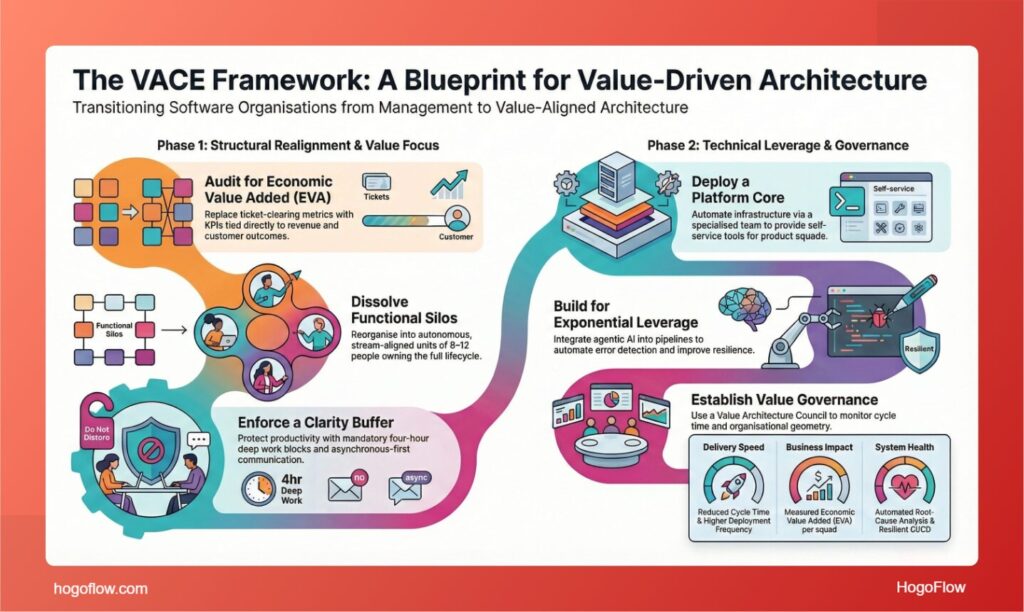
1. Audit for Economic Value Added (EVA)
- Objective: Ensure every team contributes measurable business impact.
- Actions:
- Conduct quarterly EVA reviews for all squads.
- Disband or reassign teams that fail to show revenue, retention, or cost-reduction impact.
- Replace “ticket clearing” metrics with KPIs tied directly to customer outcomes.
2. Eliminate Functional Silos
- Objective: Reduce coordination drag and increase autonomy.
- Actions:
- Dissolve separate “Frontend,” “Backend,” and “QA” departments.
- Reorganize into stream-aligned units of 8–12 people.
- Each unit owns the full lifecycle: discovery → design → development → deployment.
- Mandate that feature launches require zero cross-departmental syncs.
3. Deploy a Platform Core
- Objective: Simplify infrastructure and reduce cognitive load.
- Actions:
- Select the top 10% of engineering talent for a Platform Team.
- Automate infrastructure, security, and deployment pipelines.
- Provide self-service tools so product teams can focus on customer-facing innovation.
4. Enforce a Clarity Buffer
- Objective: Protect deep work and minimize distractions.
- Actions:
- Transition to asynchronous-first communication.
- Implement mandatory “Deep Work” blocks (minimum 4 hours/day).
- Establish “No-Meeting Days” across the organization.
- Limit Slack/Teams interruptions with structured communication protocols.
5. Build for Exponential Leverage
- Objective: Create an antifragile system that learns and improves at scale.
- Actions:
- Integrate agentic AI models into CI/CD pipelines and documentation.
- Automate error detection and root-cause analysis.
- Design systems to learn from outages and continuously improve resilience.
- Encourage teams to treat AI augmentation as a core architectural principle, not a productivity hack.
6. Governance & Monitoring
- Objective: Maintain alignment and prevent regression into chaos.
- Actions:
- Establish a Value Architecture Council to oversee EVA audits and structural integrity.
- Review organizational geometry quarterly to ensure stream-alignment remains intact.
- Track metrics: cycle time, deployment frequency, customer satisfaction, and EVA impact.
Outcome: By shifting from people management to value architecture, the organization reduces complexity drag, accelerates delivery, and scales intelligently without suffocating under its own mass.
The Verdict
If you are too busy “fixing the pipes” to notice the reservoir is running dry, you aren’t managing—biding time until the system fails. The answer to scaling is never more headcount. It is always better architecture. Mastery requires moving beyond maintenance and taking control of the machine itself.
I have documented the internal logic of the VACE Principles for those ready to move from maintenance to mastery:
https://hogoflow.com/vace-principles
Discover more from HOGOFLOW
Subscribe to get the latest posts sent to your email.