
This article is for leaders who guide organizations through rapid growth. The ideas here also apply to personal life.
When we feel overloaded, we often turn to time management. But after years of leading teams, I’ve learned: time management only treats the symptoms, not the root problem.
I now see organizations as living systems. Success doesn’t come from making people “work faster,” but from reducing friction and stopping energy leaks.
What we’re really managing is Intellectual RAM—the most sensitive and powerful factor that drives the speed of the whole system.
If that energy is wasted on “noise,” it’s like burning premium fuel in a broken engine.
Any system works best when energy is turned into useful results, not wasted. In management, waste shows up as micromanagement, endless meetings, and scattered goals. Too much friction drains energy before it can create real progress.
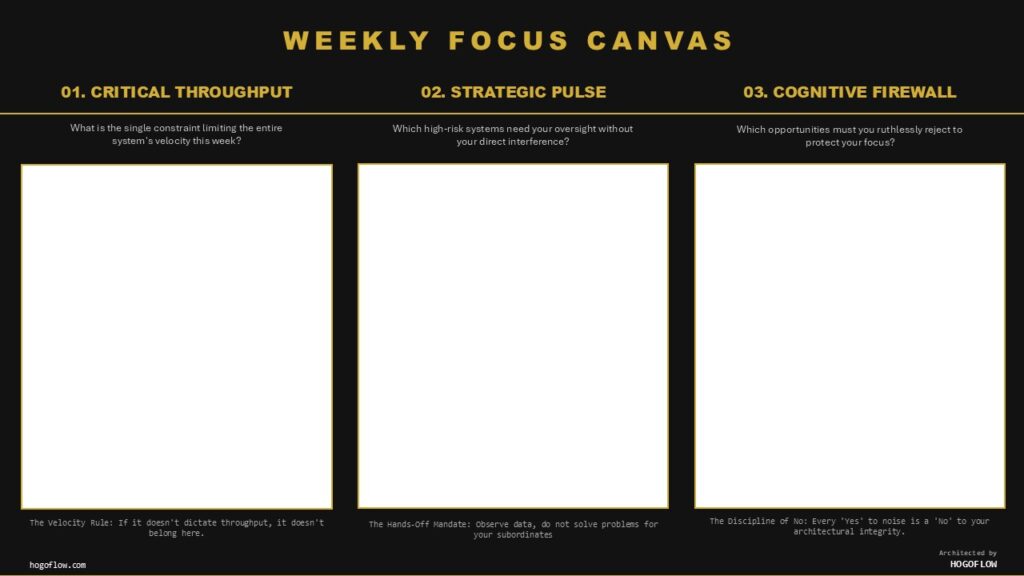
That’s why I created the Weekly Focus Protocol. It’s not about doing more—it’s about protecting clarity and directing energy where it matters most.
1. Find the Bottleneck
Many leaders waste Intellectual RAM fixing small processes or pushing teams that aren’t the real problem.
The Theory of Constraints says: improving anything other than the weakest link doesn’t help. It just creates “intellectual inventory” the system can’t use.
Don’t ask, “What is the team doing?” Ask, “What is stopping them?”
Look for where work is piling up. Is hiring too slow? Are legal approvals delayed? Is IT overloaded?
That single bottleneck is the only place where your effort truly matters. Everything else is noise.
Once you find it, focus all resources on fixing it until the flow is restored.
2. Create Strategic Checkpoints
In scaling organizations, oversight isn’t about watching people—it’s about monitoring flow.
You need to identify the critical systems that control speed. These are areas where too much involvement slows things down, but ignoring them causes chaos.
These are your Throughput Constraints: hiring, funding, product design, etc.
They don’t need your constant control. They need your Strategic Pulse—regular check-ins to make sure they’re running smoothly.
Think of it as keeping the road clear so your team’s “engine” can run at full speed.
3. Build a Cognitive Firewall
Without filters, disorder always grows. Emails, urgent requests, and “quick opportunities” are the biggest sources of noise.
Your firewall is the system that blocks distractions and protects long-term clarity.
To shift from busy manager to system architect, try this next week:
- Spend the first 30 minutes Monday finding the real bottleneck in your value stream.
- Instead of giving orders, set Logic Filters—principles that help your team make decisions without you at non-critical points.
- Choose three key metrics and only discuss those in short check-ins.
- Cut at least two tasks that look important but don’t affect the bottleneck.
Leadership isn’t about pushing the car—it’s about removing the stones under the wheels.
Your success this week isn’t measured by how much you did, but by how much smoother the system runs after seven days.
In a scaling company, your role is to design systems for sustainable growth, not fight daily fires.
The Weekly Focus Protocol is a practical tool to help you make that shift.
Download the Weekly Focus Canvas here to start filtering the noise and isolating your throughput today.
Discover more from HOGOFLOW
Subscribe to get the latest posts sent to your email.