Let’s be brutally honest about something that nobody wants to admit in the Sprint Review: Story Points are the greatest lie we tell ourselves about Value.
Don’t get me wrong. Story Points are excellent for Capacity Planning. They help your Team Lead figure out if the squad is going to burn out next week. They are a decent budgeting tool for effort. But using them to measure Business Value? That is dangerous naivety.
As a Release Train Engineer (RTE) and Value Stream Architect, I have walked into too many boardrooms where executives lull themselves to sleep with green dashboards.
You tell me your Team Velocity increased by 20% this quarter? I don’t care.
You tell me your Squad “burned down” 50 points this week? It means nothing.
If those features are sitting dead in a holding queue, or waiting for a manager to copy-paste data into a spreadsheet for a status report, your actual Velocity is zero.
The brutal reality is this: We are confusing Motion with Progress.
The Illusion of Local Optimization
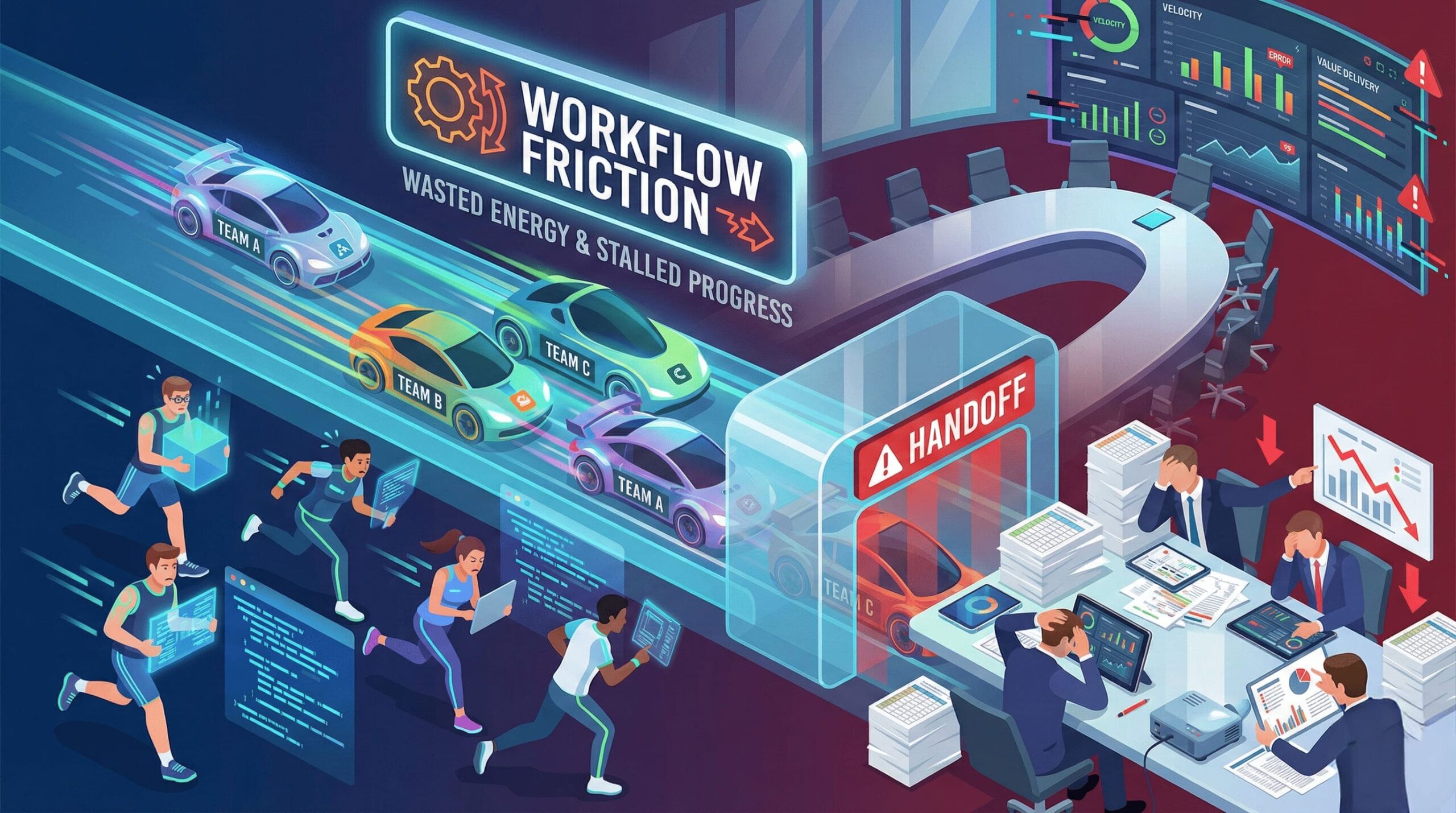
Imagine you have seven Feature Squads. They are like V8 Ferraris. They sprint at 100mph. Code is committed continuously. Jira tickets fly from “To Do” to “Done” faster than the eye can see.
But what happens when that Ferrari reaches the intersection between Development and Operations? Or the chasm between Product and Architecture?
It slams on the brakes.
The engine stalls.
And the driver (your expensive Tech Lead or PM) has to get out and push the car through a gate called “Handoff.”
If the transition between departments relies on a spreadsheet updated manually on Friday afternoon, or a painful, hour-long “Weekly Sync” meeting, then I have news for you: You are just running in place.
You are engaging in Local Optimization. You are making developers code faster, but you aren’t making the product reach the market faster. In the Theory of Constraints, if you improve any part of the system that is not the bottleneck, you are simply creating an illusion of efficiency.
And the biggest bottleneck today isn’t inside the teams. It is in the “white space” between the teams.
That is where Velocity goes to die.
The “Throw-Over-The-Wall” Culture
The silent killer in Enterprise IT isn’t bad code, and it isn’t a lack of talent. It is the “Throw-over-the-wall” culture.
- Product Managers write Specs -> Toss them over the wall to Architecture. “My job is done.”
- Architecture draws the Design -> Tosses it over the wall to Dev. “Your turn.”
- Dev builds the binary -> Tosses it over the wall to Ops/QA. “If it breaks, let me know.”
With every toss, something critical evaporates: Context.
When Ops receives a build package, they don’t understand why this feature matters to the customer. When Dev picks up a ticket, they don’t understand why the architect demanded this specific database schema.
And to fill that context vacuum, what do we do? We schedule meetings.
We meet frantically. Scrum of Scrums. Alignment Meetings. Pre-planning Meetings.
We are trying to use human effort to patch the holes of a poorly designed system.
The Tragedy of High-Paid “Data Entry Clerks”
This is the part that offends me the most as a Portfolio Director managing a budget.
Look at your Tech Leads. Look at your Product Managers, RTEs, and Engineering Managers.
These are your brightest minds. You pay them $5,000, $8,000, maybe $12,000 a month to solve complex problems, to architect strategies, to innovate.
But what are they actually doing on Friday morning?
They have 10 browser tabs open.
Tab 1: Jira.
Tab 2: The Excel Roadmap.
Tab 3: PowerPoint for the Executive Committee.
Tab 4: Slack.
They are manually copy-pasting ticket statuses from Jira to Excel. They are typing out: “Feature A is blocked waiting for API from Team B.”
They are acting as Glorified Data-Entry Clerks.
It is offensive.
It is not just a waste of money. It is a waste of intellect and passion. You cannot expect a Tech Lead to propose a breakthrough architectural solution when their brain is numb from performing stupid administrative tasks.
Worse yet, the data they report is Stale Data.
The moment they hit “Send” on that PowerPoint deck, the data is obsolete. In a true Agile environment, one hour is enough for everything to change. We are running businesses based on snapshots of the past, when we desperately need a Real-time Dashboard.
Stop Calling It “Communication Issues.” It’s a Design Flaw.
I get an allergic reaction every time I hear someone say: “Our teams have communication issues.”
No. Stop blaming the people.
Humans are forgetful. Humans are lazy. Humans hate boredom. These are Features, not Bugs, of the human operating system.
If your process relies on Bob remembering to email Alice, then your process was broken by design.
Misalignment between departments is a System Design Flaw.
And you don’t fix design flaws by forcing people to “talk more” or sending them to “soft skills training.”
You fix it with Architecture.
We don’t need more Check-ins.
We need Architectural Integration.
The Solution: Treat Handoffs as a Feature
It is time to shift your mindset. Look at your Value Stream as a software product.
In software, if Module A calls an API to Module B and it times out or drops data, we call that a Critical Bug (P0) and fix it immediately.
So why, in our process, when Team A hands off to Team B without sufficient information, do we just shrug and accept it?
To escape this chaos, here is the blueprint I apply:
1. Automate Context
Never force a Developer to ask, “Which Company Objective does this ticket serve?” Design your Jira/Linear/Azure DevOps so that information automatically cascades down. When an Epic is created, it must carry a “Payload” of context all the way down to the Task level.
2. Kill Manual Reporting
If your Tech Lead is still building reports by hand, fire that process (or fire yourself for tolerating it).
All data must be “Live.” Use APIs to pull data from the work surface (Jira/Git) directly to a management dashboard. The Boss wants to see progress? Send them a link to the Dashboard. No PowerPoint. No static PDFs.
3. Re-architect the Interface
Define the Touchpoints between teams clearly. Define the Input/Output contracts.
If Team A hasn’t provided the automated test cases, Team B has the right to Reject the Handoff. Don’t be polite. Politeness creates Technical Debt. Establish automated “Quality Gates” right in the pipeline.
The Verdict: Your Green Dashboard Is Lying
Those bright green KPIs on your monthly report might look pretty, but they are hiding a reality that is bleeding red underneath: Friction.
That friction is an Invisible Tax hitting your Net Profit every single day. It erodes employee motivation and slows down your Time-to-Market.
Stop obsessing over individual Velocity.
Start obsessing over System Flow.
Stop managing people. Start managing the work.
And please, let your Tech Leads go back to being architects. Stop forcing them to be your secretaries.
That is true Agile. The rest? That’s just Agile Theater.
Discover more from HOGOFLOW
Subscribe to get the latest posts sent to your email.