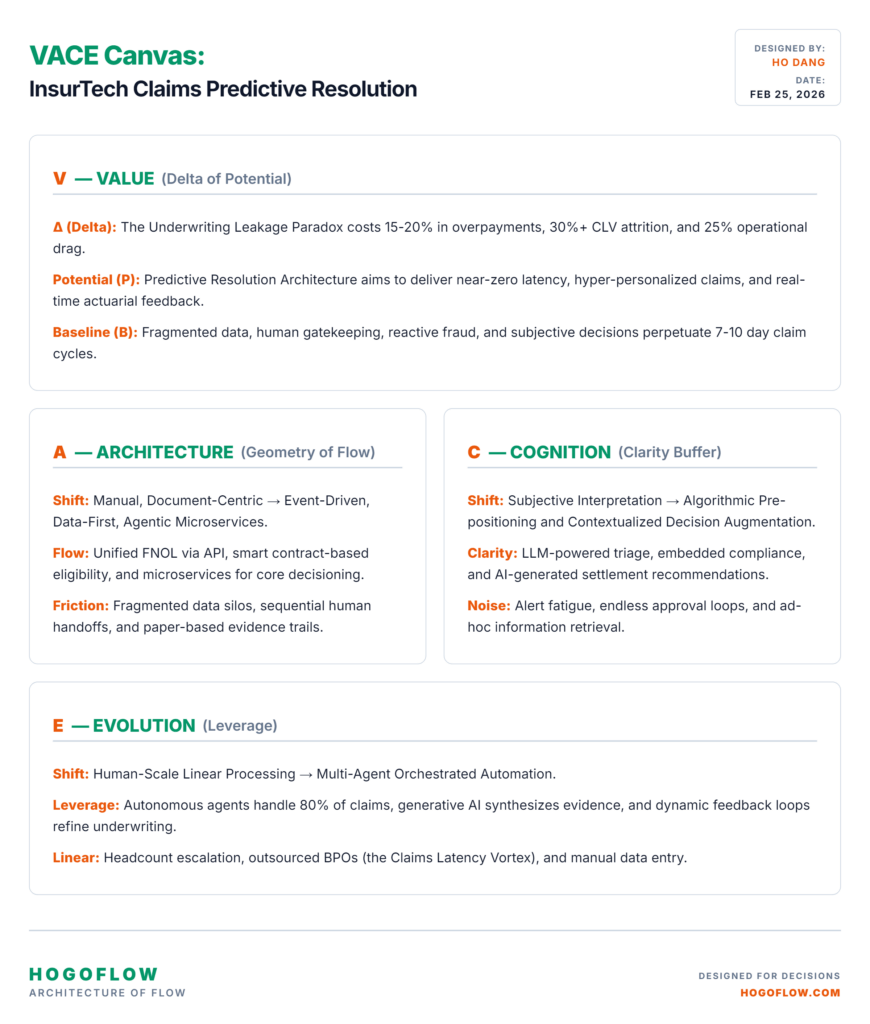
V – VALUE (Delta of Potential)
- Δ (Delta): The Underwriting Leakage Paradox costs 15-20% in overpayments, 30%+ CLV attrition, and 25% operational drag.
- Potential (P): Predictive Resolution Architecture aims to deliver near-zero latency, hyper-personalized claims, and real-time actuarial feedback.
- Baseline (B): Fragmented data, human gatekeeping, reactive fraud, and subjective decisions perpetuate 7-10 day claim cycles.
A – ARCHITECTURE (Geometry of Flow)
- Shift: Manual, Document-Centric → Event-Driven, Data-First, Agentic Microservices.
- Flow: Unified FNOL via API, smart contract-based eligibility, and microservices for core decisioning.
- Friction: Fragmented data silos, sequential human handoffs, and paper-based evidence trails.
C – COGNITION (Clarity Buffer)
- Shift: Subjective Interpretation → Algorithmic Pre-positioning and Contextualized Decision Augmentation.
- Clarity: LLM-powered triage, embedded compliance, and AI-generated settlement recommendations.
- Noise: Alert fatigue, endless approval loops, and ad-hoc information retrieval.
E – EVOLUTION (Leverage)
- Shift: Human-Scale Linear Processing → Multi-Agent Orchestrated Automation.
- Leverage: Autonomous agents handle 80% of claims, generative AI synthesizes evidence, and dynamic feedback loops refine underwriting.
- Linear: Headcount escalation, outsourced BPOs (the Claims Latency Vortex), and manual data entry.
Discover more from HOGOFLOW
Subscribe to get the latest posts sent to your email.