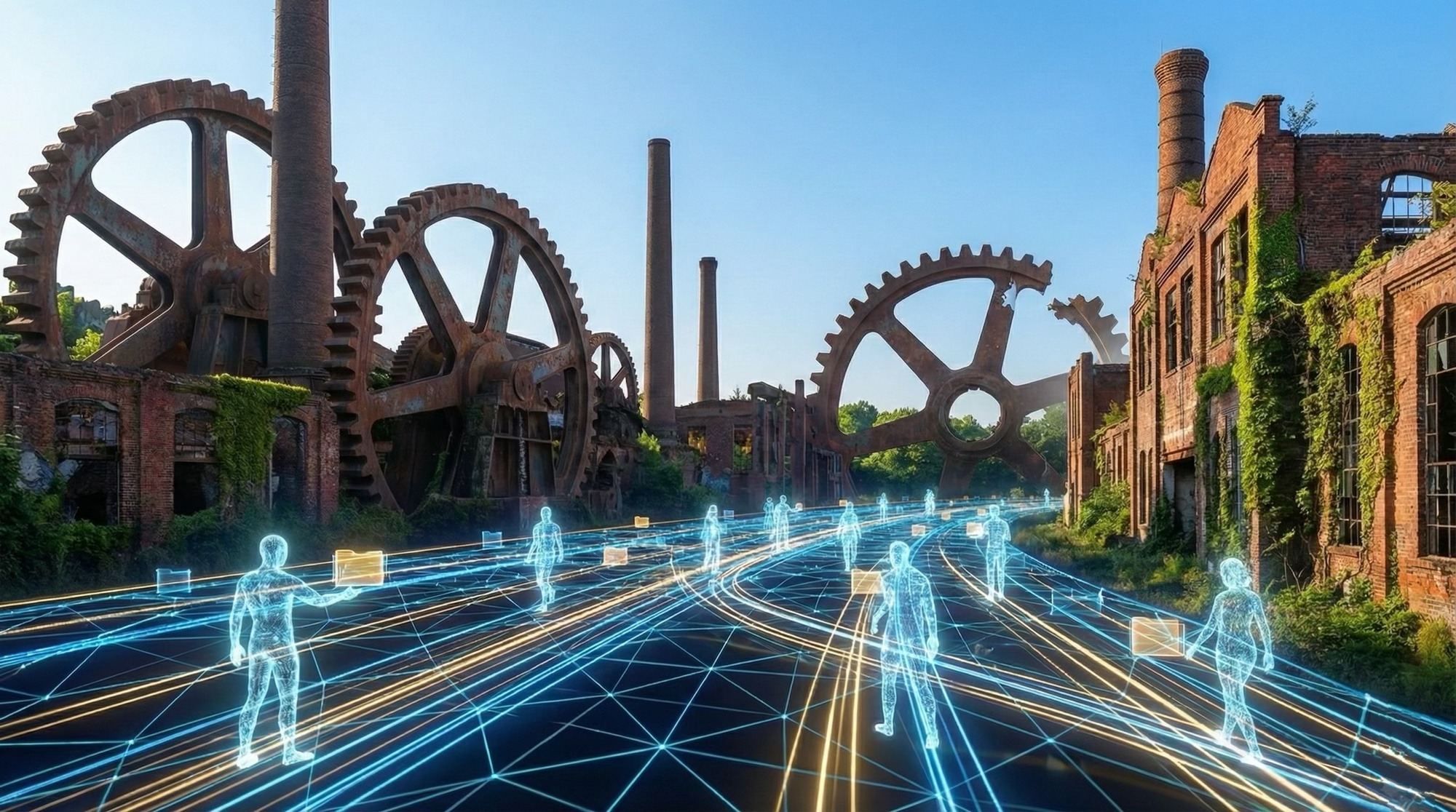
The myth of the “unskilled employee” is the most expensive delusion in the C-suite. When execution stalls, the reflexive executive impulse is to blame human capital—a lack of talent, a lack of “ownership,” or a lack of grit.
We treat turnover like a maintenance requirement, cycling through expensive hires in a desperate search for a “rockstar” who can navigate the fog. Yet, six months later, the new savior is drowning in the same inertia as their predecessor.
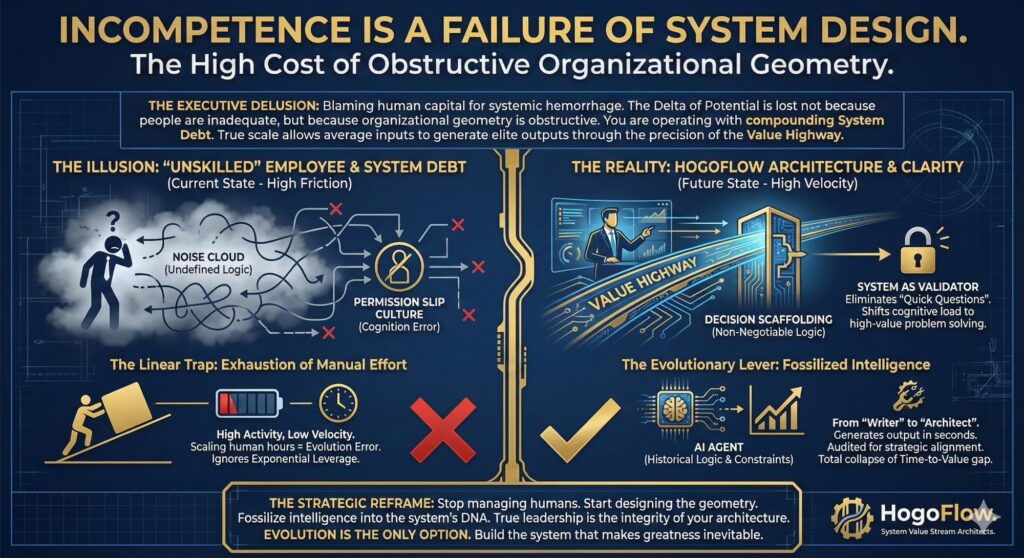
This is not a recruitment failure. It is a systemic hemorrhage. The Delta of Potential is lost not because your people are inadequate, but because your organizational geometry is obstructive.
You are operating with a massive accumulation of System Debt—the compounding cost of manual workarounds, vague logic, and centralized decision-making.
If your leadership requires “geniuses” to produce baseline results, your business model is a fragile artifact, not a scalable engine. True scale is found when the architecture allows average inputs to generate elite outputs through the precision of the Value Highway.
The Illusion of Incompetence and the Reality of System Debt
Employee failure is almost never a character flaw; it is a diagnostic signal of a structural breakdown. Most leaders view their team as independent processors, but in reality, they are components within a larger circuit.
If the circuit is poorly wired, the component burns out regardless of its quality. This breakdown usually manifests in two catastrophic friction points: the inability to act without permission and the inability to scale beyond manual effort.
We often mislabel a “passive” employee as someone who lacks initiative. In truth, they are navigating a Noise Cloud.
When the underlying logic of a business remains trapped in the CEO’s head, every employee decision becomes a high-stakes gamble.
Humans are biologically wired to avoid social and professional risk; therefore, in the absence of clear systemic guardrails, they default to the safest possible action: asking you.
This is a Cognition Error. You haven’t hired a “weak” leader; you’ve built a system that punishes autonomy and rewards bottlenecking.
The Permission Slip Culture and the Architecture of Clarity
When your inbox is a graveyard of “quick questions,” you are witnessing the failure of your Clarity Buffer.
Every time an employee asks for a “green light” on a standard task, it is a confirmation that your organizational logic has not been fossilized.
You are the scaffold, and because you are the scaffold, you are the single point of failure. The solution is not another management seminar or a “culture of empowerment” speech.
Empowerment without architecture is just chaos. You must implement Decision Scaffolding—a structural framework of non-negotiable logic that dictates how decisions are made without human intervention.
By building the “why” and the “how” into the process itself, you eliminate the need for the permission slip. The system becomes the validator.
This shifts the cognitive load from “What does the boss want?” to “Does this meet the architectural criteria?” This is the transition from managing people to engineering Flow.
The Linear Trap and the Exhaustion of Manual Effort
The second hallmark of a “bad” team is high activity paired with low velocity. These are the teams working twelve-hour days yet missing every critical deadline.
The executive diagnosis is usually “poor time management” or “lack of focus.” The architectural reality is the Linear Trap.
You are attempting to win a modern, exponential war with industrial-age spears. If your business growth is tied 1:1 to human hours, you are not building a company; you are building a labor camp.
Human effort does not scale; it only depletes. Relying on “hard work” as a strategy is a sign of Evolution Error.
It ignores the power of leverage—the ability to use technology and agentic models to multiply outcomes without increasing headcount.
When you ask a human to perform a task that a machine can do in seconds, you are not just wasting money; you are insulting their cognitive potential.
The Case of the Bottlenecked Product Team
Nowhere is this more evident than in the traditional Product team function.
In most organizations, these teams are the ultimate friction point, trapped between the “ambiguity” of the boardroom and the “rigidity” of the engineering team.
The standard executive response to a slow team is to hire a “Senior” specialist. This is a linear solution to a non-linear problem.
The new hire simply produces the same manual waste, perhaps with slightly better formatting.
When we apply VACE principles—Value, Architecture, Cognition, Evolution—the “incompetence” of the team evaporates.
The problem wasn’t their lack of technical skill; it was the lack of an Evolutionary Lever.
In a broken architecture, specialists act as manual translators, typing hundreds of pages of documentation that are obsolete by the time they are published.
By introducing an AI Agent trained on the organization’s historical logic and constraints, we shift the role from “Writer” to “Architect.”
The agent generates the output in seconds; the human audits the work for strategic alignment.
The result is a total collapse of the time-to-value gap.
A single person, armed with systemic leverage, can now outperform an entire department of “unleashed” manual workers.
The “slowness” wasn’t a person; it was a process designed for the 1990s.
This is the difference between adding more oars to a boat and installing an engine.
The Fossilization of Intelligence as a Competitive Advantage
The ultimate responsibility of a CEO is the fossilization of intelligence.
You cannot scale a company on “vibes” or “hiring the right people.”
You scale by extracting the intelligence of your best performers and baking it into the system’s DNA.
This is what it means to build a Value Highway.
If a role requires a “genius” to be successful, you have failed as an architect.
Geniuses are a scarce resource with high churn risk.
A robust system is one where the “smarts” are in the walls, the tools, and the logic gates.
This allows your team to spend their limited cognitive bandwidth on high-value problem solving rather than reinventing the wheel every Tuesday.
You aren’t being “nice” by keeping a struggling employee; you are being negligent by using their manual labor to plug the leaks in your own leaky pipes.
The Brutal Truth of Executive Sabotage
If you are frustrated with your team’s performance, look in the mirror.
You are likely the primary obstacle to their success.
Your refusal to document logic, your addiction to being the “final decider,” and your skepticism of exponential leverage are the weights around their necks.
You are making excuses for a lack of structural discipline by blaming “human error.”
In a well-architected system, human error is mitigated because the system doesn’t allow it.
If a mistake reaches the customer, it is a system flaw, not a person flaw.
By blaming the person, you are protecting your ego and ensuring the error happens again.
You are thinking linearly in an exponential world, and that is the fastest way to become a relic.
The “rockstars” you are looking for are already on your payroll.
They are just buried under layers of noise, manual labor, and permission-seeking.
They are waiting for you to stop being a manager and start being a designer.
If they are failing, it is because they are following the path you laid out—a path filled with friction, ambiguity, and low-leverage tasks.
The Strategic Reframe
Stop trying to fix your people. They aren’t broken; your geometry is.
Your job is not to motivate the water to flow faster; your job is to remove the rocks from the riverbed and widen the banks.
This is the only path to sustainable ROI.
Demand that your system gets smarter so your people can stay human.
Build the scaffolds that make failure impossible.
Deploy the leverage that makes growth exponential.
The moment you stop being a manager of humans and start being an Architect of Flow, the “incompetence” you see today will transform into the high-velocity execution you’ve been chasing.
True leadership is not about the strength of your will, but the integrity of your architecture.
Waste is the enemy. Stagnation is death. Evolution is the only option.
Build the system that makes greatness inevitable.
Discover more from HOGOFLOW
Subscribe to get the latest posts sent to your email.