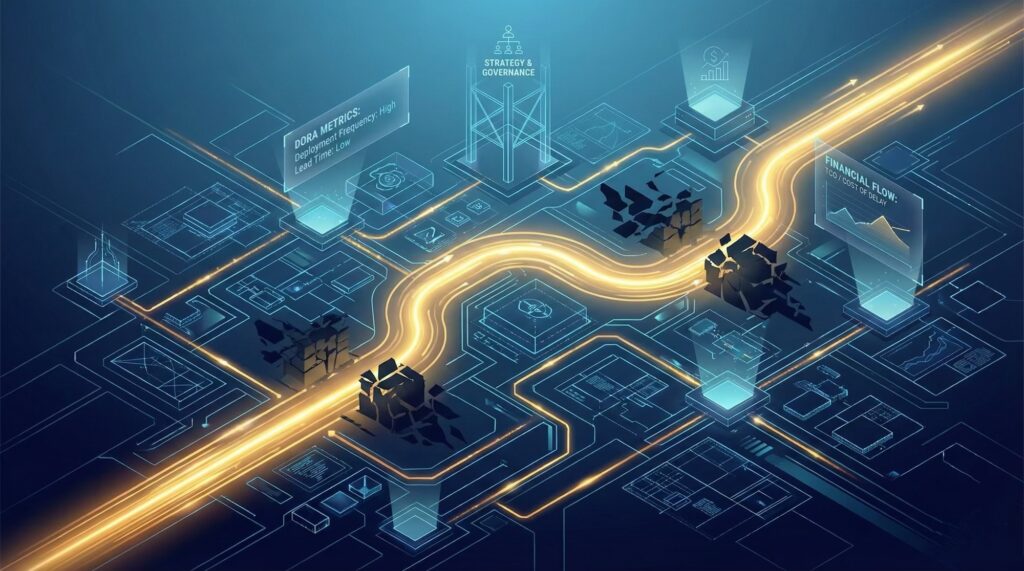
A comprehensive terminology reference organized by domain: Strategy, SAFe, DORA Metrics, Technical Architecture, and Organizational Dynamics. Perfect for interviews and daily workflow.
This list has been restructured from a random collection of terms into a logical workflow that matches a VSA’s daily responsibilities: Strategy → Analysis → Measurement → Architecture → Organization → Tooling → Action.
PART 1: STRATEGY, GOVERNANCE & FINANCE
For high-level planning, aligning with stakeholders, and managing budgets.
Core Strategic Concepts
- Value Stream: The sequence of activities to design, produce, and deliver value.
- Operational Value Stream: The business flow (delivering to the customer).
- Development Value Stream: The software flow (building the systems).
- Value Stream Identification: The process of defining the boundaries of value streams.
- Lean Thinking: Maximizing customer value while minimizing waste.
- Systems Thinking: Viewing the organization as a complex, interactive whole.
- Theory of Constraints: Identifying the most important limiting factor (bottleneck).
- Business Agility: The ability to respond quickly to market changes.
- Customer Centricity: Putting the customer at the center of every decision.
SAFe & Portfolio Management
- Lean Portfolio Management (LPM): Aligning strategy and execution via Lean thinking.
- Value Stream Funding: Funding teams/streams rather than temporary projects.
- Agile Release Train (ART): A long-lived team of teams delivering value.
- Solution Train: A construct for building large, complex solutions.
- PI Planning (Program Increment): A cadence-based planning event.
- Epic: A significant solution development initiative.
- Enablers: Technical work supporting the Architectural Runway.
- Architectural Runway: Existing infrastructure necessary to support upcoming features.
- Governance by Exception: Intervening only when metrics fall outside safety bounds.
- WSJF (Weighted Shortest Job First): Prioritization model for maximum economic benefit.
Financials & ROI
- Cost of Delay: The economic impact of not delivering on time.
- Capex vs. Opex: Capital Expenditure (assets) vs. Operating Expenditure (subscriptions/usage).
- ROI (Return on Investment): (Net Profit / Cost of Investment) x 100.
- TCO (Total Cost of Ownership): Direct and indirect costs of a system.
- Value Added (VA): Activities the customer pays for.
- Non-Value Added (NVA): Regulatory/necessary tasks that don’t add direct value.
PART 2: MAPPING, ANALYSIS & FLOW OPTIMIZATION
For “Gemba walks,” workshops, and finding bottlenecks.
Mapping & Visualization
- Value Stream Mapping: Visualizing flow to identify waste.
- Current State Map: A snapshot of current flaws and delays.
- Future State Map: The ideal workflow design.
- Gemba Walk: Observing the actual work process in person.
- Visualize Work: Making invisible knowledge work visible (e.g., Kanban).
- Cumulative Flow Diagram (CFD): Chart visualizing work flow and bottlenecks.
Time & Efficiency Definitions
- Lead Time: Total time from request to delivery.
- Cycle Time: Time to complete one specific task.
- Process Time: Touch time (actually working on the item).
- Wait Time: Time work sits in a queue.
- Flow Efficiency: (Active Value-Added Time / Total Lead Time) %.
- Little’s Law: Avg items in system = Arrival rate x Avg time in system.
Constraints & Waste
- Muda (Waste): Activity that consumes resources but adds no value.
- Bottleneck: A point of congestion slowing the system.
- WIP (Work in Process): Work started but not finished.
- Batch Size: Amount of work moving between stages at once.
- Queue Depth: Number of items waiting at a step.
- Handoff Friction: Loss of context/time when work changes owners.
- Context Switching: Productivity loss from jumping between tasks.
- Single Piece Flow: Moving one item at a time (ideal state).
PART 3: METRICS & DASHBOARDS
For monitoring the health of the delivery pipeline.
DORA Metrics (DevOps Health)
- Deployment Frequency: How often code is released.
- Lead Time for Changes: Time from commit to production.
- MTTR (Mean Time to Recovery): Average time to fix a failure.
- Change Failure Rate: Percentage of releases resulting in failure.
Flow Metrics (Value Stream Health)
- Flow Velocity: Number of items completed in a timeframe.
- Flow Time: Elapsed time from start to finish.
- Flow Load: Number of items currently in progress.
- Flow Distribution: Ratio of work types (Feature vs. Defect vs. Debt).
Quality & Reliability Metrics
- Percent Complete & Accurate (%C&A): Quality of output between steps (rework loop measure).
- Defect Density: Defects per size of software.
- Escaped Defects: Bugs found by customers in production.
- Technical Debt Ratio: Cost to fix debt / Cost to rebuild.
- Uptime: System availability.
- Churn Rate (Code): Code rewritten/deleted shortly after writing.
- NPS (Net Promoter Score): Customer satisfaction proxy.
PART 4: TECHNICAL ARCHITECTURE & PATTERNS
For designing the systems that enable flow and decoupling.
Architectural Patterns
- Monolith: Unified, hard-to-scale application.
- Microservices: Independent services to improve deployability.
- Event-Driven Architecture (EDA): Decoupled apps communicating via events.
- Domain-Driven Design (DDD): Aligning code with business domains.
- Bounded Context: Distinct boundaries for a model (critical for VSM).
- Strangler Fig Pattern: Migrating legacy systems incrementally.
- Anti-Corruption Layer: Translation layer between systems.
- Sidecar Pattern: Helper processes attached to main apps.
- Loose Coupling: Components that can be released independently.
Deployment & Infrastructure
- CI/CD Pipeline: Continuous Integration/Continuous Delivery.
- Infrastructure as Code (IaC): Managing infra via definition files.
- Immutable Infrastructure: Servers are replaced, never modified.
- Service Mesh: Infrastructure layer for service communication.
- GitOps: Git as the source of truth for infra/apps.
- Canary Release: Rolling out to a small user subset first.
- Blue/Green Deployment: Using two environments to reduce downtime.
- Dark Launching: Releasing to production but hiding from users.
- Feature Toggles: Modifying behavior without changing code.
- Circuit Breaker: Pattern to prevent recurring failures.
PART 5: ORGANIZATION, CULTURE & PEOPLE
For structuring teams and managing the “Human Stack.”
Team Structure & Dynamics
- Conway’s Law: Architecture mirrors communication structures.
- Inverse Conway Maneuver: Changing org structure to fix architecture.
- Team Topologies: Framework for team organization (Stream-aligned, Platform, etc.).
- Stream-Aligned Team: Team aligned to a single value stream.
- Platform Team: Team providing internal self-service services.
- Enabling Team: Experts helping other teams bridge gaps.
- Cross-Functional Teams: Diverse skills in one team.
- Silos: Isolated departments.
- Cognitive Load: Mental effort limit for teams.
- Dunbar’s Number: Limit to stable social relationships.
- Bus Factor: Risk of knowledge loss if key members leave.
Culture & Leadership
- Psychological Safety: Safe to speak up without fear.
- Generative Culture: Performance-oriented, cooperative.
- Servant Leadership: Leader serves the team.
- Mission Command: Focus on intent, not how.
- Radical Candor: Caring personally, challenging directly.
- Change Fatigue: Exhaustion from constant organizational change.
- Communities of Practice (CoP): Interest groups sharing knowledge.
- HiPPO: Highest Paid Person’s Opinion (anti-pattern).
PART 6: TOOLING, DATA & INTEGRATION
For managing the Value Stream Management Platform (VSMP).
Integration & Data Flow
- Value Stream Management Platform (VSMP): Tools integrating the toolchain.
- DevOps Toolchain: The set of tools for delivery.
- Common Data Model: Standard format for cross-tool data.
- Traceability: Linking requirements to code/deployments.
- Event Bus: Pipeline for pushing events.
- Webhooks: Automated messages for tool integration.
- API Gateway: Entry point for backend APIs.
- ETL (Extract, Transform, Load): Moving data to analytics.
- Data Lake: Centralized raw data repository.
- Log Aggregation: Centralizing logs (Splunk/ELK).
Tooling Specifics
- Artifact Repository: Storage for binary files (Nexus/Artifactory).
- CMDB: Database of hardware/software assets.
- Internal Developer Platform (IDP): Self-service layer for devs.
- ChatOps: Managing workflows via chat (Slack).
- Synthetic Monitoring: Simulating user transactions.
- Distributed Tracing: Tracking requests across microservices.
- Shift Left: Testing/Security earlier in the process.
- Shift Right: Testing/Observability in production.
PART 7: THE VSA ACTION KIT
Common phrases used when defining work or writing resumes/reports.
- Accelerate delivery: Speed up time to market.
- Architect for flow: Design systems for continuous delivery.
- Automate handoffs: Remove manual friction.
- Break down monoliths: Refactor into microservices.
- Bridge silos: Connect disparate teams.
- Calibrate WIP: Adjust limits to match capacity.
- Conduct post-mortems: Analyze incidents blamelessly.
- Decouple dependencies: Reduce reliance between teams.
- Democratize data: Make flow data accessible.
- Eliminate waste: Remove non-value-added tasks.
- Establish guardrails: Set safety limits for autonomy.
- Evangelize DevOps: Promote culture and practices.
- Identify constraints: Find bottlenecks.
- Institutionalize quality: Make QA part of culture.
- Minimize handoffs: Reduce ownership changes.
- Optimize the whole: Improve the system, not local parts.
- Orchestrate the pipeline: Manage automated flow.
- Perform gap analysis: Compare current vs. future state.
- Rationalize the portfolio: Align projects with strategy.
- Reduce batch sizes: Break work into smaller chunks.
- Refactor legacy: Improve old code structure.
- Shorten feedback loops: Faster info to developers.
- Throttle demand: Control work intake.
- Visualize work: Make the invisible visible.