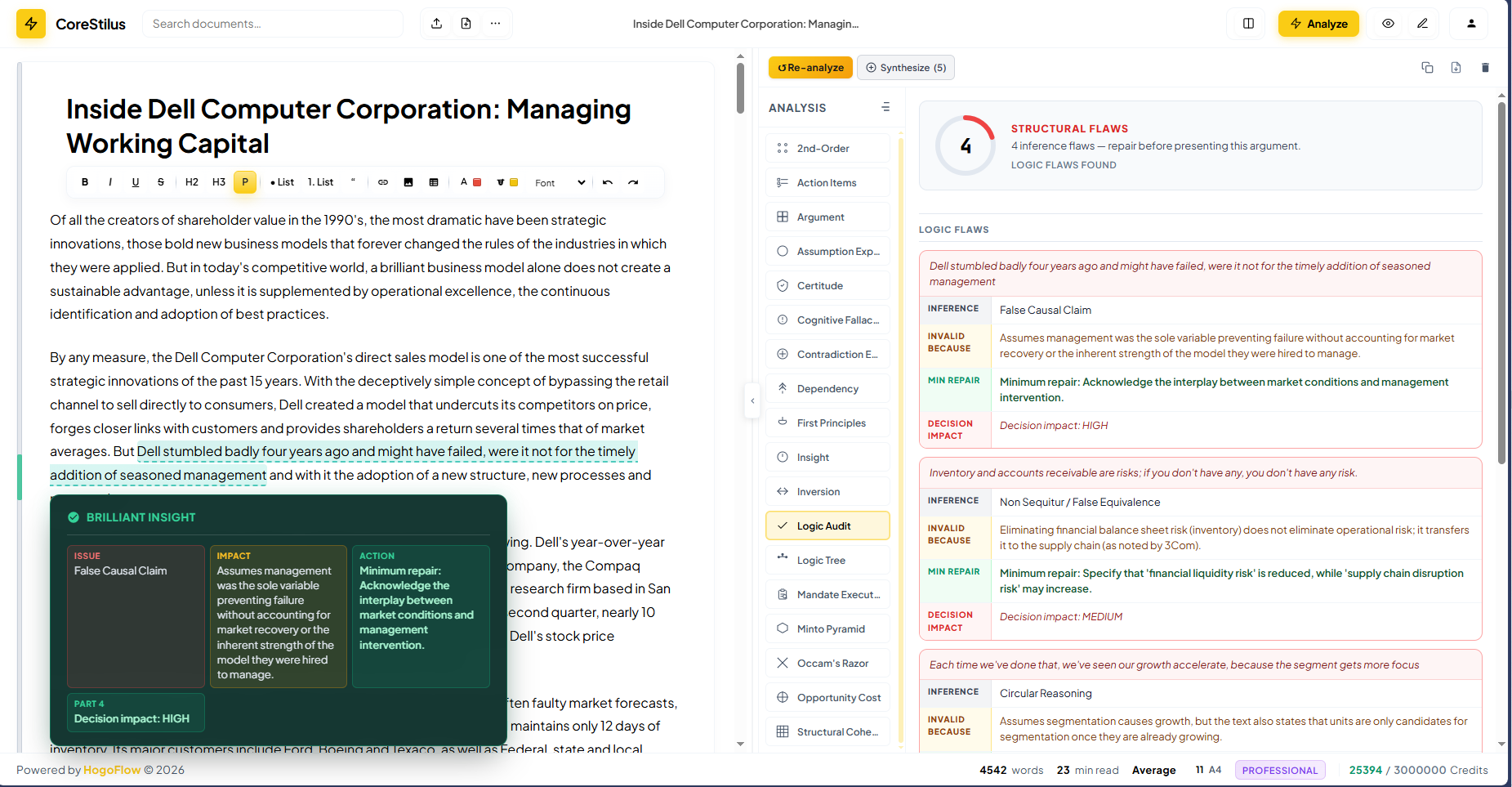
Structural clarity for every insight. CoreStilus distills complex information into logical frameworks, using classical mental models to cut through noise and spotlight what drives decisions.
Already have an account? Sign in →
18+ classical frameworks deploy automatically—Minto Pyramid, First Principles, Inversion, Occam's Razor applied without manual effort.
→ Professional reasoning, zero manual workCuts through noise to expose the logical architecture underneath. You see assumptions, contradictions, and reasoning structure—not drowning in context.
→ Decision clarity in minutes, not hoursEvery claim is tested. Hidden assumptions surface. You know exactly which statements carry your decision logic and which are vulnerable under scrutiny.
→ Defensible reasoning from first principlesInternal inconsistencies surface before they collapse your decision under boardroom challenge. Your logic holds, or the system shows you why it doesn't.
→ Stronger, more coherent decisionsLoad source material, CoreStilus deploys mental models automatically, extracts logical structure, exposes assumptions—receive actionable clarity decision-makers can stand behind.
Paste or upload the source: investment memos, contracts, strategic reports, due diligence packs, policy papers, or fragmented multi-source inputs.
Stress-tests against mental models — First Principles, Inversion, Second-Order Effects — to surface structural failures before critical review.
A verdict-first mandate with explicit reasoning, surfaced assumptions, and dependencies mapped — ready for boardroom review, regulatory submission, or investment sign-off.
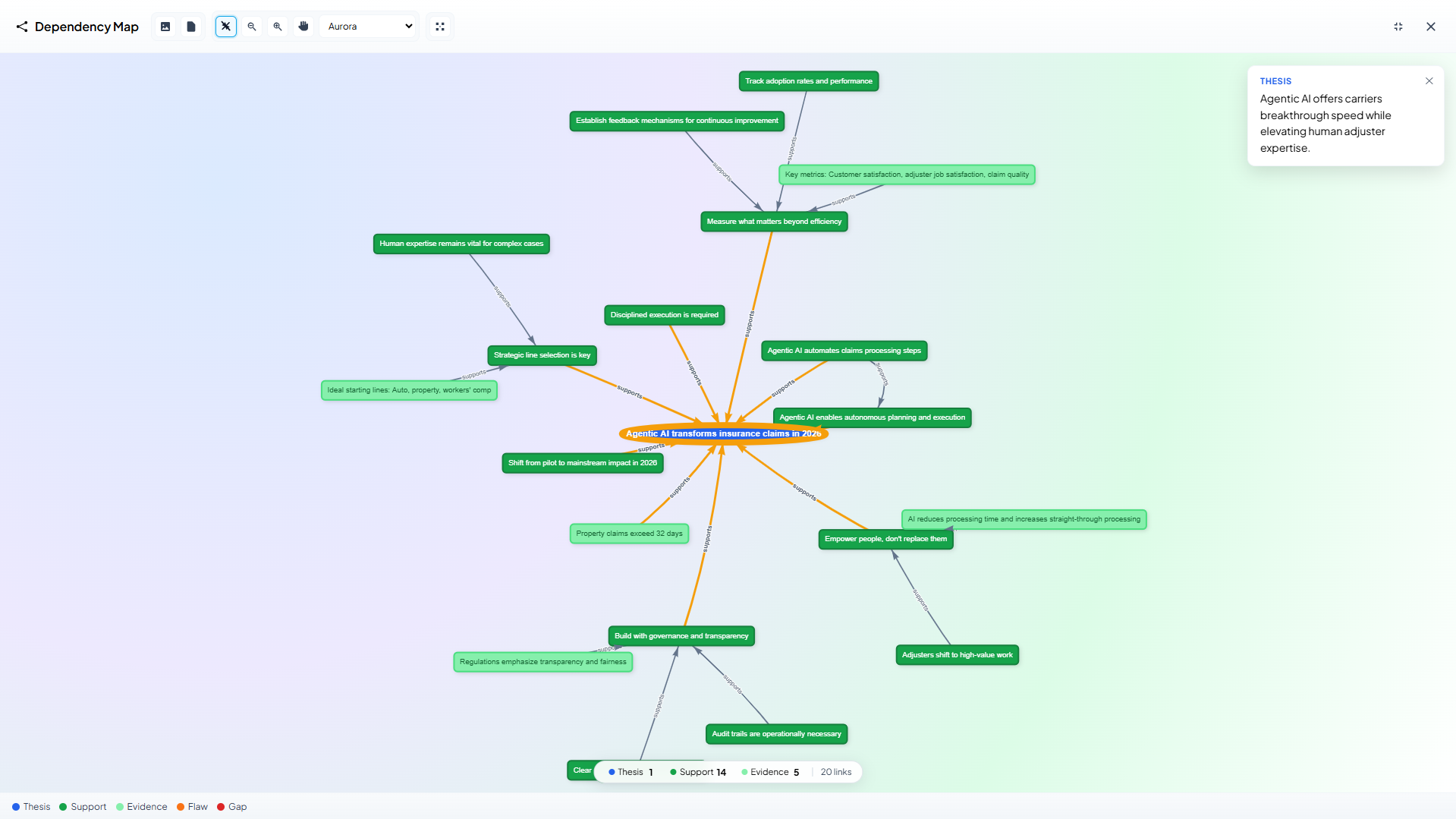
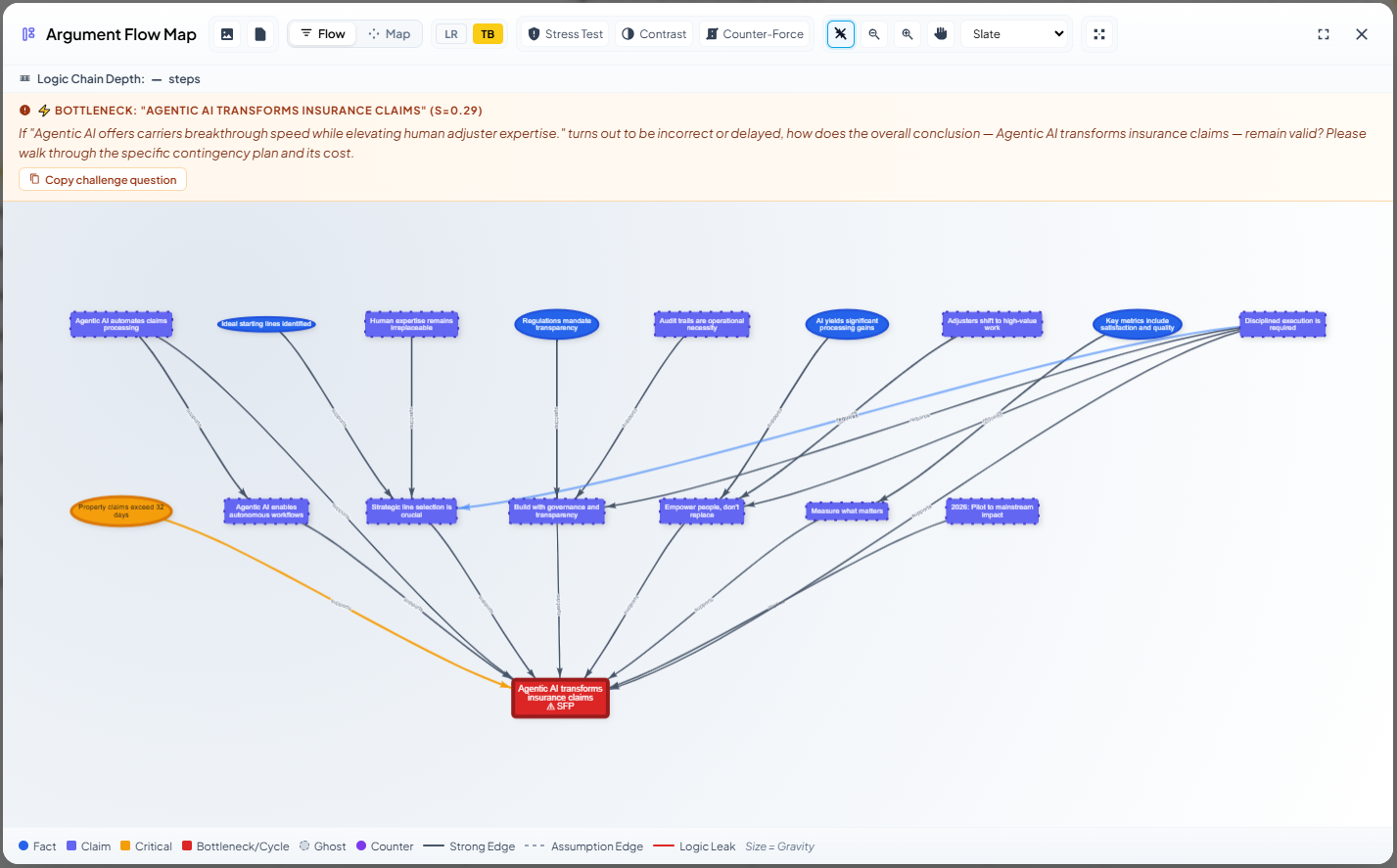
When decision-makers need more than prose, CoreStilus exposes the underlying reasoning graph — so dependencies, logic paths, and structural weak points become immediately visible.
The Dependency Map clarifies which nodes carry the mandate, which claims are under-supported, and where a weak assumption can destabilize the entire document.
The Argument Flow Map shows whether document logic progresses cleanly from problem to call-to-action — and where the chain leaks force, introduces contradiction, or drifts from its stated purpose.
Nothing is ever stored on our servers. All documents and edits are saved only on your device.
AI inputs are processed in-session and never retained. Saved documents are yours alone — accessible and permanently deletable only by you.
Your proprietary logic frameworks, risk models, and competitive intelligence are never used to train AI systems. Your intellectual capital stays yours, completely.
Data transits through encrypted channels. AI inputs are never written to persistent storage. Saved documents are stored in a private, isolated workspace.
Direct answers for leaders evaluating whether CoreStilus belongs inside a serious critical document workflow.
CoreStilus is built for critical documents where the cost of logic failure is significant: investment memos, board briefings, legal submissions, due diligence reports, strategic mandates, regulatory filings, policy papers, and any document that will be reviewed, challenged, or executed under pressure.
General AI helps produce language. CoreStilus audits decision logic. It stress-tests the reasoning behind the document, surfaces hidden assumptions and structural contradictions, and delivers a mandate that is materially easier to defend when it reaches a board, court, regulator, or investment committee.
No. The maps support the written mandate. They give decision-makers a faster way to inspect argument dependencies, reasoning paths, and structural weak points when a document needs deeper scrutiny before critical submission or review.
No. Your material is never used to train AI systems. Document content moves through encrypted channels, is not retained after processing, and any saved documents remain inside your private workspace.
Most teams can move from raw source material to a logic-audited, decision-ready mandate in minutes. The primary gain is not speed alone — it is the confidence that the document logic has been stress-tested before it reaches a boardroom, regulatory body, or investment committee.